
The MAX1473 is a fully integrated low-power CMOS super-heterodyne receiver that is ideal for receiving amplitude-shift-keyed (ASK) data in the 300MHz to 450MHz frequency range. It has a signal range from -114dBm to 0dBm. With few external components and a low-current power-down mode, it is suitable for cost- and power-sensitive applications in the automotive and consumer markets. The chip consists of a low-noise amplifier (LNA), a fully differential image-rejection mixer, an on-chip phase-locked loop (PLL) with integrated voltage-controlled oscillator (VCO), a 10.7MHz IF limiting amplifier stage with received-signal-strength indicator (RSSI), and analog baseband data-recovery circuitry. The MAX1473 also has a discrete one-step automatic gain control (AGC) that drops the LNA gain by 35dB when the RF input signal is greater than -57dBm. The MAX1473 is available in 28-pin TSSOP and 32-pin thin QFN packages. Both versions are specified for the extended (-40°C to +85°C) temperature range. Applications include automotive remote keyless entry, security systems, garage door openers, home automation, remote controls, local telemetry, and wireless sensor systems.
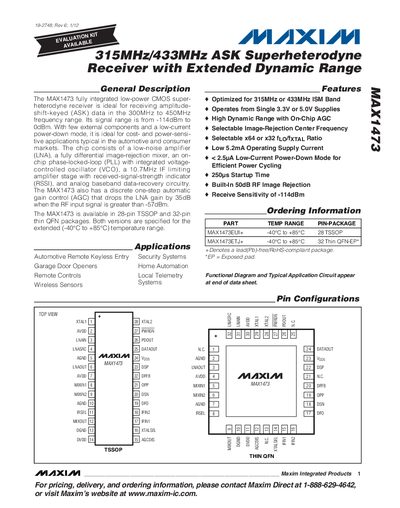
The MAX1473 is a fully integrated low‑power CMOS super‑heterodyne receiver optimized for 315 MHz or 433 MHz ISM bands. It offers high dynamic range, on‑chip AGC, and selectable image‑rejection frequencies, making it suitable for security systems, home automation, automotive remote keyless entry, garage door openers, and other remote‑control applications.
The datasheet provides absolute maximum ratings, DC and AC electrical characteristics, typical operating curves, pin descriptions, functional diagrams, and package information for the 28‑pin TSSOP and 32‑pin thin QFN versions. It also includes ordering information and revision history.
| Frequency range | 300 MHz to 450 MHz |
|---|---|
| Supply voltage (typical) | 3.3 V |
| Package options | 28‑pin TSSOP, 32‑pin thin QFN |
The device operates from a nominal 3.3 V supply (typical range 3.0 V to 3.6 V).