
The MAX19995A is a dual-channel downconverter from Texas Instruments that is designed to provide 8.7dB of conversion gain, +24.8dBm input IP3, +13.5dBm 1dB input compression point, and a noise figure of 9.2dB for 1700MHz to 2200MHz diversity receiver applications.
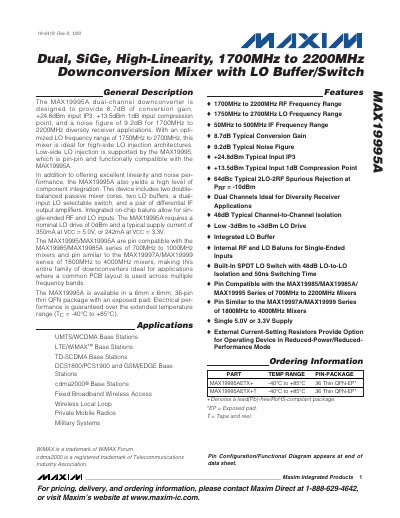
The MAX19995A dual‑channel downconverter is designed for diversity receiver applications in the 1700 MHz to 2200 MHz band. It integrates two double‑balanced passive mixer cores, LO buffers, a selectable LO switch and differential IF amplifiers, all in a 36‑pin thin QFN package.
Key features include 8.7 dB typical conversion gain, 9.2 dB typical noise figure, +24.8 dBm input IP3, and a supply current of 350 mA at 5 V (242 mA at 3.3 V). The device operates from –40 °C to +85 °C and supports LO frequencies from 1750 MHz to 2700 MHz.
| RF Frequency Range | 1700 MHz – 2200 MHz |
|---|---|
| LO Frequency Range | 1750 MHz – 2700 MHz |
| IF Frequency Range | 50 MHz – 500 MHz |
| Typical Conversion Gain | 8.7 dB |
| Typical Input IP3 | +24.8 dBm |
| Typical Input 1 dB Compression Point | +13.5 dBm |
| Supply Current @5 V | 350 mA |
| Package | 36‑pin thin QFN (6 mm × 6 mm) with exposed pad |
The MAX19995A provides a typical conversion gain of 8.7 dB.
At a 5 V supply the device draws about 350 mA of current.