
The MAX19995 dual-channel downconverter provides 9dB of conversion gain, +24.8dBm input IP3, +13.3dBm 1dB input compression point, and a noise figure as low as 9dB for 1700MHz to 2200MHz diversity receiver applications.
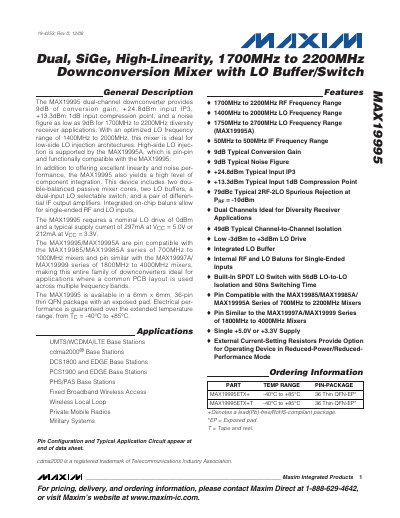
The MAX19995 dual‑channel downconverter provides 9 dB of conversion gain, +24.8 dBm input IP3, and a typical noise figure of 9 dB for 1700 MHz‑2200 MHz diversity receiver applications. It integrates two double‑balanced passive mixer cores, LO buffers, a selectable LO switch, and differential IF output amplifiers, with on‑chip baluns for single‑ended RF and LO inputs.
The device operates from a 3.3 V or 5.0 V supply, drawing 212 mA (3.3 V) or 297 mA (5.0 V). It is offered in a 6 mm × 6 mm, 36‑pin thin QFN‑EP package and is rated for –40 °C to +85 °C operation. Pin‑compatible families cover 700 MHz‑1000 MHz and 1800 MHz‑4000 MHz mixer ranges, enabling flexible PCB reuse across multiple frequency bands.
| RF Frequency Range | 1700 MHz – 2200 MHz |
|---|---|
| LO Frequency Range (low‑side) | 1400 MHz – 2000 MHz |
| LO Frequency Range (high‑side, MAX19995A) | 1750 MHz – 2700 MHz |
| IF Frequency Range | 50 MHz – 500 MHz |
| Typical Conversion Gain | 9 dB |
| Typical Noise Figure | 9 dB |
| Typical Input IP3 | +24.8 dBm |
| Typical Input 1 dB Compression | +13.3 dBm |
| Supply Voltage | 3.3 V – 5.0 V |
| Channel‑to‑Channel Isolation | 49 dB |
| LO Drive Level | -3 dBm to +3 dBm |
| Package | 6 mm × 6 mm, 36‑pin thin QFN‑EP |
The typical conversion gain is 9 dB.
It can be powered from 3.3 V up to 5.0 V.
It is offered in a 6 mm × 6 mm, 36‑pin thin QFN package with an exposed pad.
The typical noise figure is 9 dB.