
Key facts
- Brand
- Siemens
- Model
- S7-300/S7-400
- Industry
- Industrial
- Documents
- 4
- Languages
- ZH · EN
- Last added
- 2026-10-02
Start here
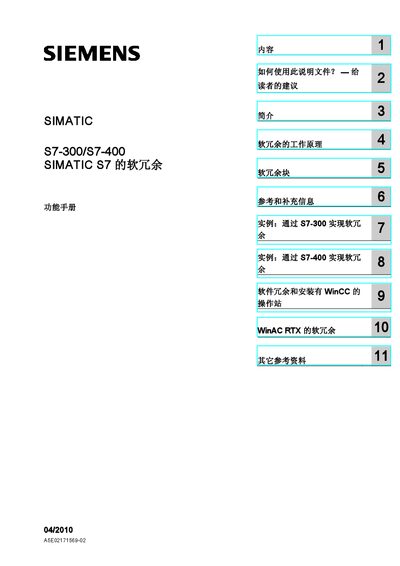
Siemens S7-300/S7-400 Soft Redundancy Function Manual
The document provides an overview of the soft‑redundancy concept for SIMATIC S7‑300 and S7‑400 systems, describing how the redundant logic operates, the structure of status and control words, and the rules for using soft redundancy. It also lists the required hardware and software components and shows where the feature can be applied.
Detailed chapters cover the soft‑redundancy block library, technical data of each block, and step‑by‑step examples for implementing redundancy on S7‑300 and S7‑400 controllers. Additional sections explain integration with WinCC operator stations, PC‑based control with WinAC RTX, and provide reference tables for supported modules and communication with other stations. This manual is written in Chinese.
All Siemens S7-300/S7-400 documents by type
Instruction set, parameters and examples for configuring or programming the device.
Day-to-day operation, settings and troubleshooting. Start here if the product is already set up.
Questions answered in these manuals
How can I enable monitoring of S7‑SCL programs?
In the compiler options select “Create debug info” and also enable “Create object code” so that variables can be monitored.
Why does the compiler report “Character strings have different lengths”?
The warning occurs when source strings have mismatched lengths; declare the shorter string variable with a larger length (e.g., 254 characters) to eliminate the error.
Which function blocks are included in the PID Control software package?
The package includes three function blocks: CONT_C, CONT_S, and PULSEGEN.
From: Siemens S7-300/S7-400 PID Control Standard Software User Manual
What operating system is required to use the PID Control parameter‑assignment interface?
The parameter‑assignment interface runs under Windows 95.
From: Siemens S7-300/S7-400 PID Control Standard Software User Manual
Who is the intended audience for this manual?
The manual is intended for S7 programmers, operators, and maintenance/service personnel.
From: Siemens S7-300 / S7-400 Ladder Logic (LAD) Programming Manual
Which version of STEP 7 software does this manual apply to?
It is valid for release 3.0 of the STEP 7 programming software package.
From: Siemens S7-300 / S7-400 Ladder Logic (LAD) Programming Manual