
This manual explains the soft‑redundancy feature for Siemens S7‑300 and S7‑400 PLCs, covering principles, blocks, configuration and example applications.
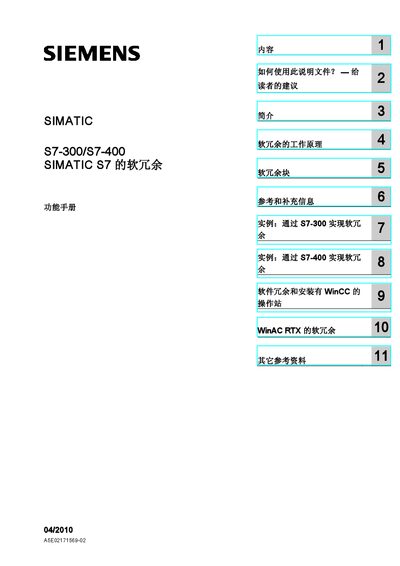
The document provides an overview of the soft‑redundancy concept for SIMATIC S7‑300 and S7‑400 systems, describing how the redundant logic operates, the structure of status and control words, and the rules for using soft redundancy. It also lists the required hardware and software components and shows where the feature can be applied.
Detailed chapters cover the soft‑redundancy block library, technical data of each block, and step‑by‑step examples for implementing redundancy on S7‑300 and S7‑400 controllers. Additional sections explain integration with WinCC operator stations, PC‑based control with WinAC RTX, and provide reference tables for supported modules and communication with other stations. This manual is written in Chinese.
Section 3.2 lists the hardware needed for implementing soft redundancy.
Supported modules are listed in section 6.9 of the manual.
The switching time is described in section 6.3.
Section 6.5 provides the DP slave switching time for ET200M.