
Key facts
- Brand
- STMicroelectronics
- Model
- AN303
- Documents
- 3
- Languages
- EN
- Last added
- 2012-08-06
Start here
STMicroelectronics AN303 Thyristors and TRIACs Latching Current Application Note
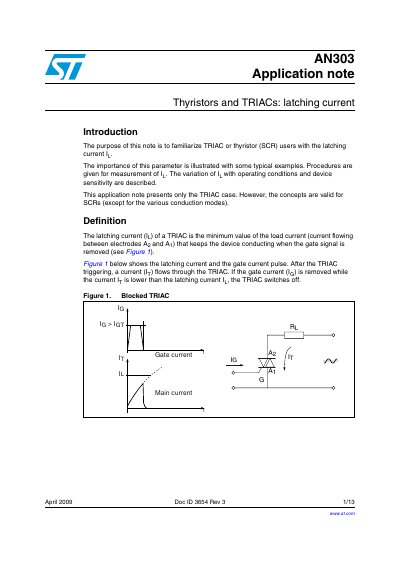
The document defines the latching current (I_L) as the minimum load current required to keep a TRIAC or SCR conducting after the gate signal is removed. It highlights the importance of this parameter through application examples involving low power lamps, inductive loads like AC motors, and arc welding circuits where varying power can cause triggering issues.
Read onlineSTMicroelectronics AN303 specifications
| Input voltage range | 85 to 265 Vac |
|---|---|
| Line frequency | 50/60 Hz |
| Number of lamps | 2 |
| Lamp type and configuration | T8 in parallel configuration |
| Power per lamp | 58 W |
| Power factor | 0.9 |
| Total harmonic distortion | 10% |
| Efficiency | 90% |
Source: STMicroelectronics AN3032 Application Note for STEVAL-ILBO07V1 Ballast
All STMicroelectronics AN303 documents by type
How to use the product for one specific task, with worked examples.
Questions answered in these manuals
What is the latching current?
The latching current (I_L) of a TRIAC is the minimum value of the load current that keeps the device conducting when the gate signal is removed.
From: STMicroelectronics AN303 Thyristors and TRIACs Latching Current Application Note
How does junction temperature affect latching current?
The latching current varies with junction temperature; for example, a specific TRIAC's latching current increases from 20 mA at 25 °C to 32.5 mA at -40 °C.
From: STMicroelectronics AN303 Thyristors and TRIACs Latching Current Application Note
What IC is used in this ballast design?
The ballast is controlled by the L6585DE IC.
From: STMicroelectronics AN3032 Application Note for STEVAL-ILBO07V1 Ballast
How many T8 lamps can this board drive?
It is designed to drive 2 x 58 W linear T8 fluorescent tubes.
From: STMicroelectronics AN3032 Application Note for STEVAL-ILBO07V1 Ballast