
This application note introduces the concepts of gate current (IG) and holding current (IL) for thyristors (SCRs) and triacs. Also provided are procedures for measuring IG and IL, and a discussion of the variation of IL with operating conditions and device sensitivity.
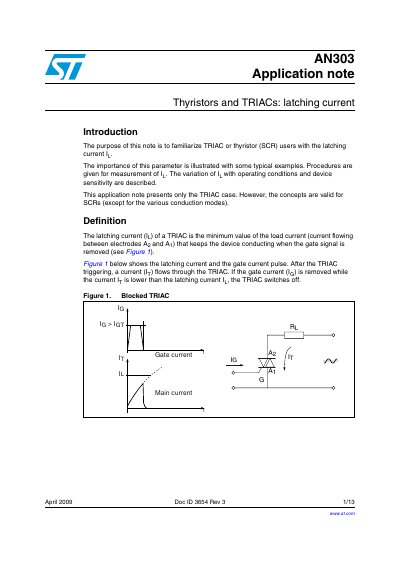
The document defines the latching current (I_L) as the minimum load current required to keep a TRIAC or SCR conducting after the gate signal is removed. It highlights the importance of this parameter through application examples involving low power lamps, inductive loads like AC motors, and arc welding circuits where varying power can cause triggering issues.
The latching current (I_L) of a TRIAC is the minimum value of the load current that keeps the device conducting when the gate signal is removed.
The latching current varies with junction temperature; for example, a specific TRIAC's latching current increases from 20 mA at 25 °C to 32.5 mA at -40 °C.