
Key facts
- Brand
- Motorola
- Model
- MC10E111
- Industry
- Industrial
- Documents
- 2
- Languages
- EN
- Last added
- 2012-07-09
Start here
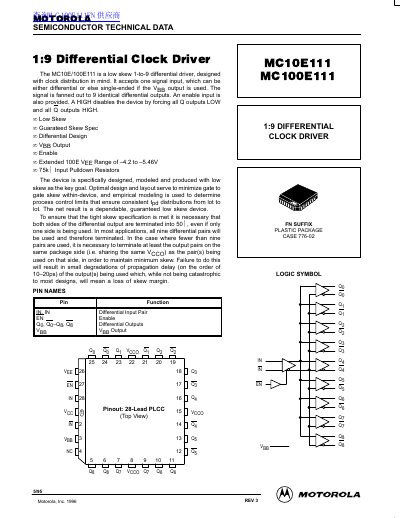
Motorola MC10E111/MC100E111 1:9 Differential Clock Driver Datasheet
This document is a technical datasheet for the Motorola MC10E111 and MC100E111, which are low skew 1-to-9 differential clock drivers designed for clock distribution applications. The devices accept a single signal input and fan it out to nine identical differential outputs, featuring an enable input and a VBB output option.
Read onlineMotorola MC10E111 specifications
| Device Type | 1-to-9 differential driver |
|---|---|
| Input Type | Differential or single-ended |
| Output Count | 9 differential outputs |
| Package Type | 28-Lead PLCC |
| Operating Temperature Range | -40°C to 85°C |
Source: Motorola MC10E111/MC100E111 1:9 Differential Clock Driver Datasheet
All Motorola MC10E111 documents by type
Ratings, dimensions and ordering codes, for selection and design work.
Questions answered in these manuals
What is the function of the enable input?
A HIGH on the enable input disables the device by forcing all Q outputs LOW and all Q outputs HIGH.
From: Motorola MC10E111/MC100E111 1:9 Differential Clock Driver Datasheet
What is the minimum input swing required?
The minimum input swing is 250 mV for AC operation.
From: Motorola MC10E111/MC100E111 1:9 Differential Clock Driver Datasheet
What is the function of the MC10E111?
It is a low skew 1-to-9 differential driver designed for clock distribution.
From: Motorola MC10E111/MC100E111 1:9 Differential Clock Driver Datasheet
Can the input be single-ended?
Yes, the input can be single-ended if the VBB output is used.
From: Motorola MC10E111/MC100E111 1:9 Differential Clock Driver Datasheet