
Key facts
- Brand
- Motorola
- Model
- MC10E151
- Industry
- Industrial
- Documents
- 2
- Languages
- EN
- Last added
- 2012-07-09
Start here
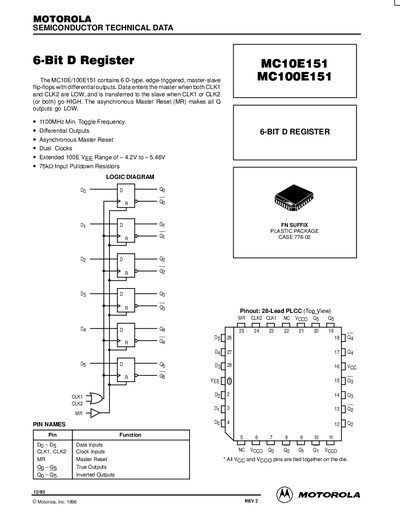
Motorola MC10E151/MC100E151 6-Bit D Register Datasheet
This document is a technical datasheet for the Motorola MC10E151 and MC100E151, which are 6-bit D-type registers. The devices contain 6 D-type, edge-triggered, master-slave flip-flops with differential outputs. Data enters the master when both clocks are low and transfers to the slave when either clock goes high. An asynchronous Master Reset (MR) forces all outputs low.
Read onlineMotorola MC10E151 specifications
| Number of Flip-Flops | 6 |
|---|---|
| Output Type | Differential |
| Max Toggle Frequency (MC10E) | 1100 MHz |
| Max Toggle Frequency (MC100E) | 1400 MHz |
| Package Type | 28-Lead PLCC |
| Package Case Number | 776-02 |
Source: Motorola MC10E151/MC100E151 6-Bit D Register Datasheet
All Motorola MC10E151 documents by type
Ratings, dimensions and ordering codes, for selection and design work.
Questions answered in these manuals
What is the function of the MR pin?
The asynchronous Master Reset (MR) makes all Q outputs go LOW.
From: Motorola MC10E151/MC100E151 6-Bit D Register Datasheet
When is data transferred from master to slave?
Data is transferred to the slave when CLK1 or CLK2 go HIGH.
From: Motorola MC10E151/MC100E151 6-Bit D Register Datasheet
What is the function of the MR pin?
The asynchronous Master Reset (MR) makes all Q outputs go LOW.
From: Motorola MC10E151/MC100E151 6-Bit D Register Datasheet
When does data transfer to the slave occur?
Data is transferred to the slave when CLK1 or CLK2 (or both) go HIGH.
From: Motorola MC10E151/MC100E151 6-Bit D Register Datasheet