
The MC10E/100E111 is a low skew 1-to-9 differential driver, designed with clock distribution in mind. It accepts one signal input, which can be either differential or else single-ended if the VBB output is used. The signal is fanned out to 9 identical differential outputs. An enable input is also provided. A HIGH disables the device by forcing all Q outputs LOW and all Q outputs HIGH.
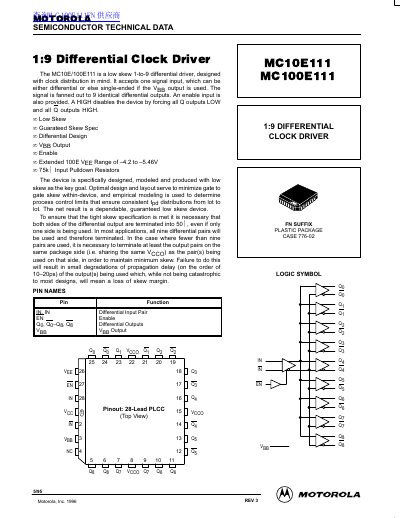
This document is a technical datasheet for the Motorola MC10E111 and MC100E111, which are low skew 1-to-9 differential clock drivers designed for clock distribution applications. The devices accept a single signal input and fan it out to nine identical differential outputs, featuring an enable input and a VBB output option.
| Device Type | 1-to-9 differential driver |
|---|---|
| Input Type | Differential or single-ended |
| Output Count | 9 differential outputs |
| Package Type | 28-Lead PLCC |
| Operating Temperature Range | -40°C to 85°C |
A HIGH on the enable input disables the device by forcing all Q outputs LOW and all Q outputs HIGH.
The minimum input swing is 250 mV for AC operation.