
Key facts
- Brand
- Motorola
- Model
- MC100E431
- Industry
- Industrial
- Documents
- 2
- Languages
- EN
- Last added
- 2012-07-10
Start here
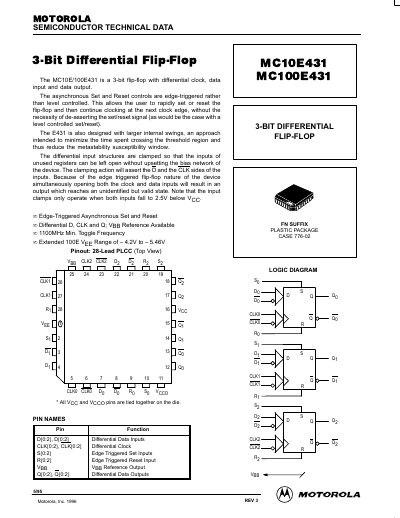
Motorola MC10E431/MC100E431 3-Bit Differential Flip-Flop Datasheet
This document is a technical datasheet for the Motorola MC10E431 and MC100E431, which are 3-bit differential flip-flops featuring differential clock, data input, and data output. The devices utilize edge-triggered asynchronous Set and Reset controls to allow rapid setting or resetting without de-asserting signals.
The datasheet provides comprehensive electrical specifications, including DC and AC characteristics such as maximum toggle frequency (1100 MHz minimum), propagation delays, and setup/hold times across temperature ranges. It also includes a pinout diagram for the 28-lead PLCC package and a logic diagram illustrating the internal structure.
Motorola MC100E431 specifications
| Maximum Toggle Frequency | 1100 MHz Min. |
|---|---|
| Package Type | 28-Lead PLCC |
| Operating Temperature Range | -40°C to 85°C |
| Vee Reference Output Voltage (10E) | -1.43V to 1.30V |
| Vee Reference Output Voltage (100E) | -1.38V to 1.26V |
| Minimum Input Swing | 150 mV |
Source: Motorola MC10E431/MC100E431 3-Bit Differential Flip-Flop Datasheet
All Motorola MC100E431 documents by type
Ratings, dimensions and ordering codes, for selection and design work.
Questions answered in these manuals
What is the minimum toggle frequency for the MC10E431?
The minimum toggle frequency is 1100 MHz.
From: Motorola MC10E431/MC100E431 3-Bit Differential Flip-Flop Datasheet
Are the Set and Reset controls level controlled?
No, the asynchronous Set and Reset controls are edge-triggered rather than level controlled.
From: Motorola MC10E431/MC100E431 3-Bit Differential Flip-Flop Datasheet
What is the minimum toggle frequency?
The device has a minimum toggle frequency of 1100 MHz.
Are the Set and Reset controls level controlled?
No, they are edge-triggered rather than level controlled.