
Key facts
- Brand
- Siemens
- Model
- RWD62
- Documents
- 4
- Languages
- EN · ZH
- Last added
- 2012-02-15
Start here
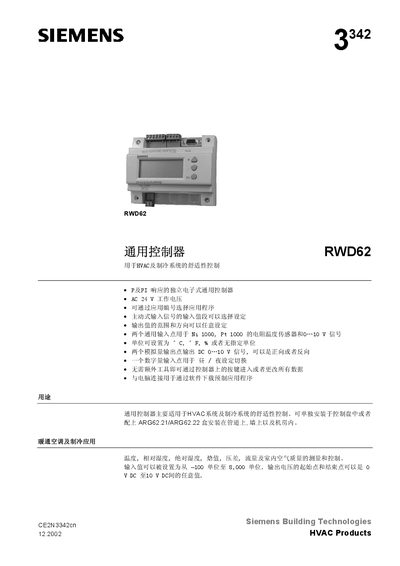
Siemens RWD62 General Controller User Manual
The RWD62 is a universal controller designed for HVAC and refrigeration comfort control. It can be mounted in a control panel or in wall‑mounted protective housings (ARG62.21/ARG62.22) and supports temperature, humidity, pressure, flow and indoor air quality measurements.
The controller offers two analog input points (X1, X2) for Ni 1000, Pt 1000 or 0‑10 V DC sensors, two analog output points (Y1, Y2) with selectable forward or reverse action, a digital input for day/night switching, and optional auxiliary functions such as PI limiting, remote set‑point, cascade control, set‑point compensation, winter/summer mode and maximum priority. This manual is written in Chinese.
Siemens RWD62 specifications
| Ni100002 temperature range | -50 °C to 150 °C |
|---|---|
| Pt 100022 temperature range | -20 °C to 180 °C |
| 0‑10 Vde input range | -100 to 8000 |
Source: Siemens RWD62 Service Manual
All Siemens RWD62 documents by type
Day-to-day operation, settings and troubleshooting. Start here if the product is already set up.
Disassembly, diagnostics and part numbers, for repair.
Questions answered in these manuals
What is the temperature range for the Ni100002 sensor?
The Ni100002 sensor operates from –50 °C to 150 °C.
What is the temperature range for the Pt 100022 sensor?
The Pt 100022 sensor operates from –20 °C to 180 °C.
What is the operating voltage of the RWD62 controller?
The controller operates on AC 24 V with a tolerance of ±20 %.
How many analog input points does the RWD62 have?
It has two analog input points (X1 and X2) that accept Ni 1000, Pt 1000 or 0‑10 V DC signals.
What is the power consumption of the controller?
The controller consumes 2.5 VA.
What is the operating voltage of the RWD62?
It operates from an AC 24 V supply (±20 %).