
Design Note 339 describes an autoranging true RMS-to-DC converter that adds an LTC6910-2 PGA to the LTC1966 to reach an 80dB input range.
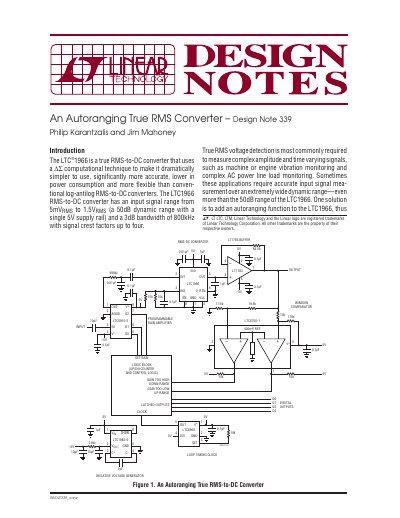
This design note by Philip Karantzalis and Jim Mahoney describes the LTC1966, a true RMS-to-DC converter that uses a delta-sigma computational technique instead of the conventional log-antilog approach. The LTC1966 has an input signal range from 5mV RMS to 1.5V RMS, a 50dB dynamic range on a single 5V supply rail, a 3dB bandwidth of 800kHz, and handles signal crest factors up to four.
The note shows how to extend that range with an autoranging loop: an LTC6910-2 programmable gain amplifier in front of the LTC1966, an LT1783 buffer, an LT6700-1 window comparator with a 400mV reference, an up/down counter, and an LTC6900 oscillator that sets the loop response time. The circuit runs from a single 5V supply with an LTC1983-5 charge pump inverter for the negative rail, reaches an 80dB input dynamic range with a 12Hz to 32kHz conversion bandwidth, and reports the gain setting through digital outputs.
| Input signal range | 5mV RMS to 1.5V RMS |
|---|---|
| Dynamic range (single 5V supply) | 50dB |
| 3dB bandwidth | 800kHz |
| Signal crest factor | up to four |
| Autoranging input dynamic range | 80dB |
| Autoranging conversion bandwidth | 12Hz to 32kHz |
| Window comparator thresholds | 9.5mV and 1.5V |
| PGA gain settings | 1, 2, 4, 8, 16, 32 or 64 |
| Conversion error | less than 1% from 50mV RMS to 1.5V RMS input, rising to 5% at 9.5mV RMS |
| 1% error bandwidth | 6kHz |
The LTC1966 accepts 5mV RMS to 1.5V RMS, a 50dB dynamic range on a single 5V supply rail.
The autoranging true RMS-to-DC conversion bandwidth is 12Hz to 32kHz.
It indicates an under range condition: the input signal is too low and the autorange circuit cannot provide more gain, so the PGA gain is set to 64.