
Key facts
- Brand
- Analog Devices
- Model
- AD5228
- Industry
- Industrial
- Documents
- 4
- Languages
- ZH · EN
- Last added
- 2026-11-16
Start here
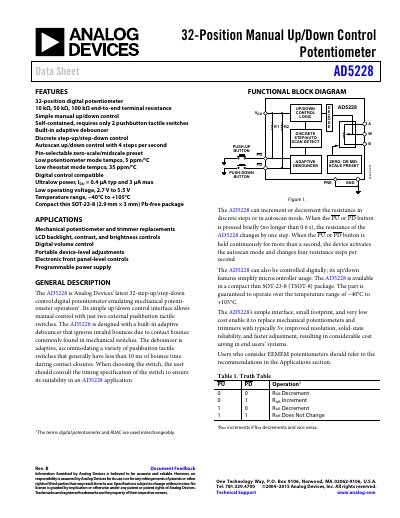
Analog Devices AD5228 32-Position Digital Potentiometer Data Sheet
The AD5228 is a 32-step digital potentiometer from Analog Devices, designed to replace mechanical potentiometers. It features manual up/down control via two pushbutton switches and an auto scan mode for continuous adjustment. The device includes an adaptive debouncer to handle switch bounce and operates over a wide temperature range of -40°C to +105°C. It is available in a compact SOT-23-8 package and supports resistor values of 10 kΩ, 50 kΩ, or 100 kΩ.
The datasheet details electrical characteristics, pin configurations, timing diagrams, and application examples including LCD backlight control, audio volume control, and LED drivers. This manual is written in Chinese.
Analog Devices AD5228 specifications
| Terminal Resistance | 10 kΩ, 50 kΩ, 100 kΩ |
|---|---|
| Operating Temperature Range | -40°C to +105°C |
| Package Type | SOT-23-8 |
| Supply Voltage | 2.7 V to 5.5 V |
| Power Supply Standby Current | 0.4 µA typical, 3 µA maximum |
| Resolution | 5 Bits |
| Temperature Coefficient (Rheostat Mode) | 35 ppm/°C |
| Temperature Coefficient (Potentiometer Mode) | 5 ppm/°C |
| Bandwidth (RAB = 10 kΩ) | 460 kHz |
| Total Harmonic Distortion | 0.05 % |
Source: Analog Devices AD5228 32-Position Digital Potentiometer Data Sheet
All Analog Devices AD5228 documents by type
Ratings, dimensions and ordering codes, for selection and design work.
Questions answered in these manuals
What is the operating voltage range of the AD5228?
The AD5228 operates on a voltage range of 2.7 V to 5.5 V.
From: Analog Devices AD5228 32-Position Digital Potentiometer Data Sheet
What is the temperature range for the AD5228?
The AD5228 operates over a temperature range of -40°C to +105°C.
From: Analog Devices AD5228 32-Position Digital Potentiometer Data Sheet
How many external switches are required for manual control?
The AD5228 requires only two pushbutton tactile switches for simple manual up/down control.
What is the function of the built-in debouncer?
The built-in adaptive debouncer ignores invalid bounces due to contact bounce commonly found in mechanical switches.
How is the AD5228 controlled manually?
It uses two external push‑button tactile switches for up and down functions, with a built‑in adaptive debouncer to ignore contact bounce.
What does the autoscan mode do?
When a push‑button is held for more than one second, the device enters autoscan mode and changes the resistance by four steps per second.