
The document describes the features and characteristics of the AD5228, a 32-position manual up/down control potentiometer. It includes 10 kΩ, 50 kΩ, and 100 kΩ end-to-end terminal resistance, simple manual control, built-in adaptive debouncer, discrete step-up/step-down control, autoscan up/down control, pin-selectable zero-scale/midscale preset, low potentiometer mode tempco, low rheostat mode tempco, digital control compatibility, ultralow power, low operating voltage, automotive temperature range, and compact thin package.
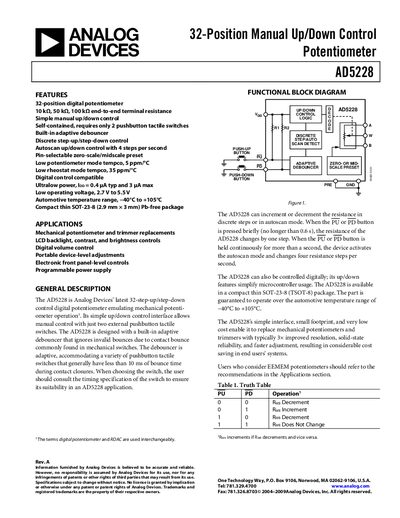
The AD5228 digital potentiometer provides 32 discrete positions and can be operated manually with two tactile push‑button switches for up/down control. It includes a built‑in adaptive debouncer, autoscan mode (four steps per second when a button is held), and optional digital control interfaces.
Typical applications include replacing mechanical potentiometers and trimmers in LCD backlight control, audio volume, programmable power supplies, and other portable device adjustments. The device operates from 2.7 V to 5.5 V, draws sub‑nanoamp currents, and is qualified for the automotive temperature range of –40 °C to +105 °C in a compact SOT‑23‑8 package.
| Operating voltage range | 2.7 V to 5.5 V |
|---|---|
| Supply active current | 50–110 pA (typical) |
| Potentiometer mode temperature coefficient | 5 ppm/°C |
| Rheostat mode temperature coefficient | 35 ppm/°C |
| Power consumption (typical/max) | 0.4 pA typ, 3 pA max |
It uses two external push‑button tactile switches for up and down functions, with a built‑in adaptive debouncer to ignore contact bounce.
When a push‑button is held for more than one second, the device enters autoscan mode and changes the resistance by four steps per second.
The device is qualified for an automotive temperature range from –40 °C to +105 °C.