
Key facts
- Brand
- Analog Devices
- Model
- AD9670
- Category
- Other Electronics
- Industry
- Health
- Documents
- 2
- Languages
- ZH · EN
- Last added
- 2026-11-11
Start here
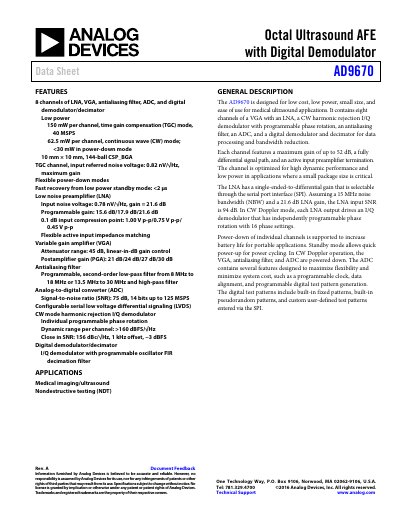
Analog Devices AD9670 Octal Ultrasound AFE Data Sheet
The AD9670 is an octal ultrasound analog front-end (AFE) designed for low cost, low power, and small size. It integrates eight channels of low noise amplifiers (LNA), variable gain amplifiers (VGA), antialiasing filters, 14-bit analog-to-digital converters (ADC), and digital demodulators/decimators. The device is optimized for medical ultrasound imaging and nondestructive testing (NDT) applications. This manual is written in Chinese.
Read onlineAnalog Devices AD9670 specifications
| Channels | 8 |
|---|---|
| Package | 10 mm × 10 mm, 144-ball CSP_BGA |
| Power (TGC Mode) | 150 mW per channel |
| Power (CW Mode) | 62.5 mW per channel |
| Power (Power-down) | <30 mW |
| ADC Resolution | 14 bits |
| ADC Sampling Rate | Up to 125 MSPS |
| Signal-to-Noise Ratio (SNR) | 75 dB |
| Input Noise Voltage (LNA) | 0.78 nV/√Hz |
| Dynamic Range | >160 dBFS/√Hz |
Source: Analog Devices AD9670 Octal Ultrasound AFE Data Sheet
All Analog Devices AD9670 documents by type
Ratings, dimensions and ordering codes, for selection and design work.
Questions answered in these manuals
What are the main applications of the AD9670?
The AD9670 is designed for medical imaging/ultrasound and nondestructive testing (NDT) applications.
What is the power consumption in TGC mode?
The power consumption is 150 mW per channel in time gain compensation (TGC) mode.
What is the maximum gain per channel for the AD9670?
Each channel features a maximum gain of up to 52 dB.
How many phase settings are available for the I/Q demodulator in CW Doppler mode?
The demodulator has independently programmable phase rotation with 16 phase settings.