
Key facts
- Brand
- Toshiba
- Model
- TLP1024
- Industry
- Industrial
- Documents
- 2
- Languages
- EN · JA
- Last added
- 2012-06-01
Start here
Toshiba TLP1024 Photointerrupter Infrared LED+Photo IC Datasheet
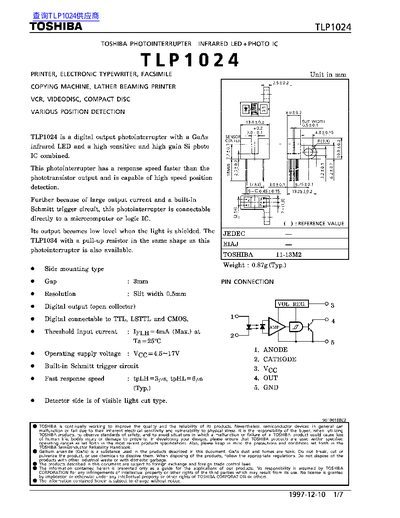
The TLP1024 is a digital‑output photointerrupter that combines a GaAs infrared LED with a high‑gain Si photodiode. It offers a fast response and a built‑in Schmitt trigger, allowing direct connection to microcontrollers or logic ICs.
The document lists maximum ratings, recommended operating conditions, opto‑electrical characteristics, and mechanical dimensions such as a 0.5 mm slit width and 8 mm gap. Precautions for soldering, cleaning, and packaging materials are also included to ensure reliable performance.
Toshiba TLP1024 specifications
| Maximum Forward Current | 50 mA |
|---|---|
| Reverse Voltage | 5 V |
| Supply Voltage (Vcc) | 4.5 V – 17 V |
| Output Voltage | 30 V |
| Power Dissipation | 250 mW |
| Operating Temperature Range | -25 °C – 85 °C |
| Recommended LED Forward Current | 14 mA – 20 mA |
| Typical Propagation Delay (low‑to‑high) | 3 µs |
| Typical Propagation Delay (high‑to‑low) | 6 µs |
| Slit Width | 0.5 mm |
| Gap (pin spacing) | 8 mm |
| Weight | 0.87 g |
Source: Toshiba TLP1024 Photointerrupter Infrared LED+Photo IC Datasheet
All Toshiba TLP1024 documents by type
Ratings, dimensions and ordering codes, for selection and design work.
Questions answered in these manuals
What is the typical propagation delay of the TLP1024?
Typical low‑to‑high delay (tpLH) is 3 µs and high‑to‑low delay (tpHL) is 6 µs.
From: Toshiba TLP1024 Photointerrupter Infrared LED+Photo IC Datasheet
What supply voltage range should be used with the TLP1024?
The device operates with a supply voltage between 4.5 V and 17 V.
From: Toshiba TLP1024 Photointerrupter Infrared LED+Photo IC Datasheet
What is the supply voltage range for the TLP1024(F)?
The device operates with a supply voltage (Vcc) from 4.5 V to 17 V.
What is the typical response time of the photointerrupter?
The typical low‑to‑high transition time is 3 µs and the high‑to‑low time is 6 ns (standard).