
Key facts
Start here
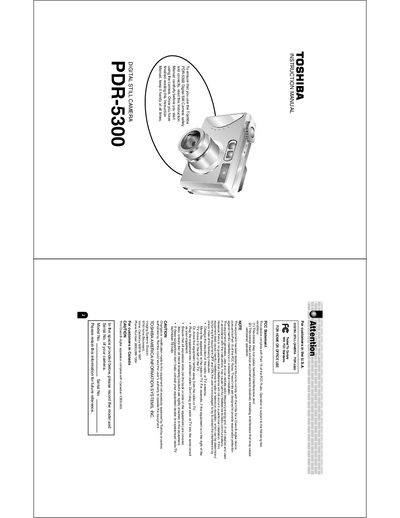
Toshiba PDR-5300 Digital Still Camera Instruction Manual
This manual begins with safety precautions, proper handling of the camera, battery, and AC adapter, and a list of included accessories. It explains how to avoid hazards such as water intrusion, electrical shock, and radio‑frequency interference, and gives guidance on storing the camera and batteries safely.
The later sections cover camera operation: turning the power on/off, menu navigation, photography modes, flash, focus, exposure, and image playback. It also describes connecting the camera to a PC (Windows or Macintosh), using the supplied software, firmware upgrades, and troubleshooting tips.
Toshiba PDR-5 specifications
| Battery type | Lithium‑ion (PDR‑BT3) |
|---|---|
| Battery nominal capacity | 1035 mAh |
| Battery operating temperature | +41 °F (45 °C) to +104 °F (440 °C) |
| Battery dimensions | 35.2 mm × 63.0 mm × 7.0 mm (W × H × D) |
| Battery weight | ≈ 289 g |
| AC adapter input voltage | 100 V to 240 V AC, 50/60 Hz |
| AC adapter output | 5 V DC, 3 A |
Source: Toshiba PDR-5300 Digital Still Camera Instruction Manual
All Toshiba PDR-5 documents by type
Day-to-day operation, settings and troubleshooting. Start here if the product is already set up.
Questions answered in these manuals
At what temperature should I store the battery?
Store the battery in a cool, dry place with a surrounding temperature of +59 °F (15 °C) to +77 °F (25 °C).
From: Toshiba PDR-5300 Digital Still Camera Instruction Manual
Can I use the PDR-5 camera while driving?
No, the manual explicitly states that the camera should not be used while driving.
What type of battery does the PDR-5 require?
The camera uses a lithium CR123A battery, and an external 3 V AC adapter can also be used.