
Key facts
- Brand
- Analog Devices
- Model
- AD8114
- Industry
- Industrial
- Documents
- 2
- Languages
- EN
- Last added
- 2012-05-03
Start here
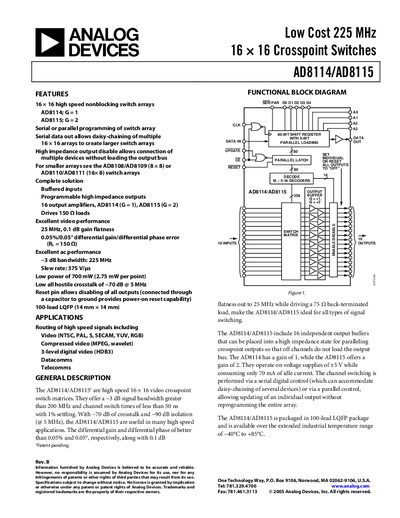
Analog Devices AD8114/AD8115 Datasheet
The AD8114 and AD8115 are 16 × 16 high‑speed video crosspoint switch matrices offering a –3 dB bandwidth greater than 200 MHz, low crosstalk (‑70 dB at 5 MHz) and programmable gain (1 × for AD8114, 2 × for AD8115). They support serial or parallel programming and can be daisy‑chained to build larger arrays.
Packaged in a 100‑lead LQFP, the devices operate from a +5 V supply, draw about 70 mA idle current, and are rated for an industrial temperature range of –40 °C to +85 °C. Detailed specifications, timing characteristics, absolute maximum ratings and ordering information are provided in the document.
Analog Devices AD8114 specifications
| Gain Flatness | 0.1 dB |
|---|---|
| Supply Voltage Range | +4.5 V to +5.5 V |
| Output Impedance (enabled) | 0.2 Ω |
All Analog Devices AD8114 documents by type
Ratings, dimensions and ordering codes, for selection and design work.
Questions answered in these manuals
What is the gain of the AD8114?
The AD8114 has a gain of 1.
What is the gain of the AD8115?
The AD8115 offers a gain of 2.
What is the gain of the AD8114 and AD8115?
The AD8114 has a gain of 1 (G = 1) and the AD8115 has a gain of 2 (G = 2).
How can the switch arrays be programmed?
They can be programmed either serially or in parallel, and the serial data output allows daisy‑chaining of multiple devices.