
This document provides preliminary technical data for the Octal Ultrasound AFE With Digital Demodulator AD9670. The product features 8 channels of LNA, VGA, AAF, ADC, and digital demodulator/decimator. It offers low power consumption, flexible power-down modes, low noise preamplifier, variable gain amplifier, and more.
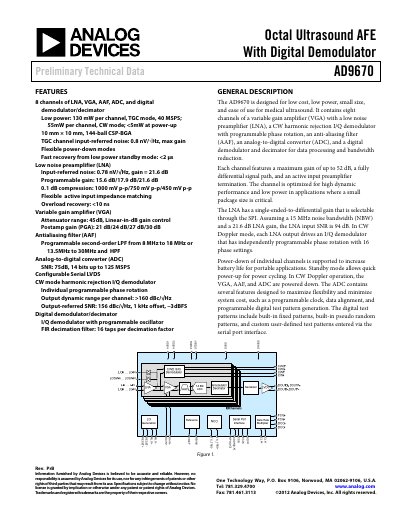
The AD9670 is an octal ultrasound analog front-end (AFE) designed for low cost, low power, and small size applications. It integrates eight channels of a variable gain amplifier (VGA) with a low noise preamplifier (LNA), a CW harmonic rejection I/Q demodulator, an anti-aliasing filter, an analog-to-digital converter, and a digital demodulator and decimator.
Each channel features a maximum gain of up to 52 dB, a fully differential signal path, and an active input preamplifier termination. The device is optimized for high dynamic performance and low power in applications where a small package size is critical, utilizing a 10 mm x 10 mm, 144-ball CSP-BGA package.
| Channels | 8 channels |
|---|---|
| Package Size | 10 mm x 10 mm |
| Power Consumption (TGC mode) | 130 mW per channel |
| Power Consumption (CW mode) | 55 mW per channel |
| LNA Input-Referenced Noise | 0.78 nV/VHz |
| ADC Resolution | 14 bits |
| Maximum Gain | 52 dB |
Each channel features a maximum gain of up to 52 dB.
The demodulator has independently programmable phase rotation with 16 phase settings.
The LNA input SNR is 94 dB assuming a 15 MHz noise bandwidth and a 21.6 dB LNA gain.