
This datasheet describes the AD9670, an octal ultrasound analog front-end chip with integrated LNA, VGA, ADC, and digital demodulator for medical imaging.
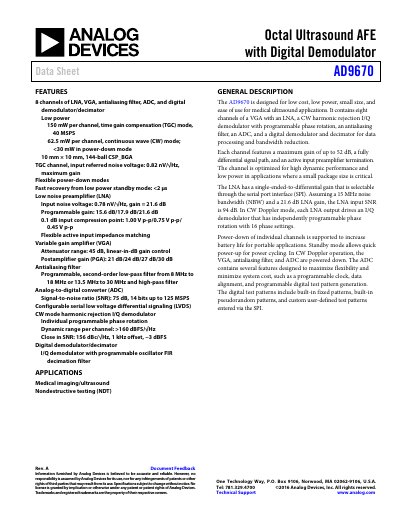
The AD9670 is an octal ultrasound analog front-end (AFE) designed for low cost, low power, and small size. It integrates eight channels of low noise amplifiers (LNA), variable gain amplifiers (VGA), antialiasing filters, 14-bit analog-to-digital converters (ADC), and digital demodulators/decimators. The device is optimized for medical ultrasound imaging and nondestructive testing (NDT) applications. This manual is written in Chinese.
| Channels | 8 |
|---|---|
| Package | 10 mm × 10 mm, 144-ball CSP_BGA |
| Power (TGC Mode) | 150 mW per channel |
| Power (CW Mode) | 62.5 mW per channel |
| Power (Power-down) | <30 mW |
| ADC Resolution | 14 bits |
| ADC Sampling Rate | Up to 125 MSPS |
| Signal-to-Noise Ratio (SNR) | 75 dB |
| Input Noise Voltage (LNA) | 0.78 nV/√Hz |
| Dynamic Range | >160 dBFS/√Hz |
The AD9670 is designed for medical imaging/ultrasound and nondestructive testing (NDT) applications.
The power consumption is 150 mW per channel in time gain compensation (TGC) mode.
The ADC supports sampling rates up to 125 MSPS.