
Key facts
- Brand
- Texas Instruments
- Model
- DS3486
- Category
- INTEGRATED CIRCUITS
- Industry
- Electronics
- Documents
- 2
- Languages
- EN
- Last added
- 2026-11-23
Start here
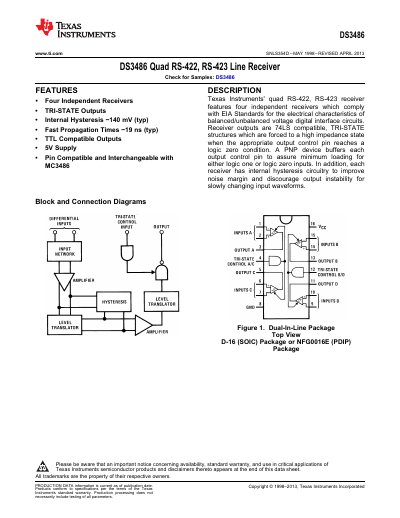
Texas Instruments DS3486 Quad RS-422/RS-423 Line Receiver Datasheet
The DS3486 is a quad RS-422 and RS-423 line receiver designed for digital interface circuits in industrial communication applications. It consists of four independent receivers that comply with EIA standards for electrical characteristics.
Key features include TRI-STATE outputs, internal hysteresis to improve noise margin, and fast propagation times. The device is powered by a 5V supply and provides 74LS compatible outputs.
Texas Instruments DS3486 specifications
| Power Supply Voltage (VCC) | 4.75V to 5.25V |
|---|---|
| Operating Temperature | 0°C to 70°C |
| Propagation Delay Time (Typical) | 19 ns |
| Input Common-Mode Voltage Range | -7.0V to 7.0V |
Source: Texas Instruments DS3486 Quad RS-422/RS-423 Line Receiver Datasheet
All Texas Instruments DS3486 documents by type
Ratings, dimensions and ordering codes, for selection and design work.
Questions answered in these manuals
What is the purpose of the internal hysteresis in the DS3486?
The internal hysteresis circuitry is used to improve noise margin and discourage output instability for slowly changing input waveforms.
From: Texas Instruments DS3486 Quad RS-422/RS-423 Line Receiver Datasheet
What is the recommended power supply voltage for this device?
The recommended power supply voltage range is from 4.75 V to 5.25 V.
From: Texas Instruments DS3486 Quad RS-422/RS-423 Line Receiver Datasheet
What supply voltage does the SN65LVDS series require?
The devices operate from a single 3.3 V supply with a permissible range of 3.0 V to 3.6 V.
What is the propagation delay of the receiver outputs?
Typical propagation delay is 2.5 ns to 6 ns for both low‑to‑high and high‑to‑low transitions.