
Key facts
- Brand
- Motorola
- Model
- MC10EL51
- Industry
- Industrial
- Documents
- 2
- Languages
- EN
- Last added
- 2012-07-10
Start here
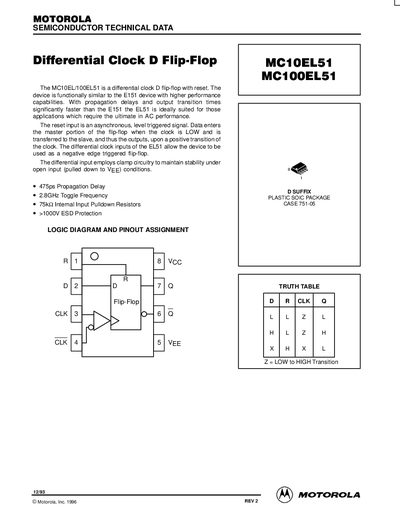
Motorola MC10EL51/MC100EL51 Differential Clock D Flip-Flop Datasheet
The MC10EL51 and MC100EL51 are differential clock D flip-flops with reset, designed for applications requiring ultimate AC performance. These devices are functionally similar to the E151 but offer significantly faster propagation delays and output transition times. The reset input is asynchronous and level-triggered, allowing data to enter the master portion when the clock is LOW and transfer to the slave upon a positive clock transition.
Read onlineMotorola MC10EL51 specifications
| Propagation Delay | 475ps |
|---|---|
| Toggle Frequency | 2.8GHz |
| Internal Input Pulldown Resistors | 75kQ |
| ESD Protection | >1000V |
| Package Type | Plastic SOIC |
Source: Motorola MC10EL51/MC100EL51 Differential Clock D Flip-Flop Datasheet
All Motorola MC10EL51 documents by type
Ratings, dimensions and ordering codes, for selection and design work.
Questions answered in these manuals
What is the function of the reset input?
The reset input is an asynchronous, level triggered signal.
From: Motorola MC10EL51/MC100EL51 Differential Clock D Flip-Flop Datasheet
When does data transfer to the slave portion?
Data is transferred to the slave and thus the outputs upon a positive transition of the clock.
From: Motorola MC10EL51/MC100EL51 Differential Clock D Flip-Flop Datasheet
What is the maximum toggle frequency of the MC10EL51?
The device supports a maximum toggle frequency of up to 2.8 GHz.
From: Motorola MC10EL51/MC100EL51 Differential Clock D Flip-Flop Datasheet
How does the reset input function on this flip-flop?
The reset input is an asynchronous, level triggered signal that resets the outputs immediately when active.
From: Motorola MC10EL51/MC100EL51 Differential Clock D Flip-Flop Datasheet