
Key facts
- Brand
- Analog Devices
- Model
- ADA4096-2
- Industry
- Industrial
- Documents
- 2
- Languages
- EN
- Last added
- 2012-05-02
Start here
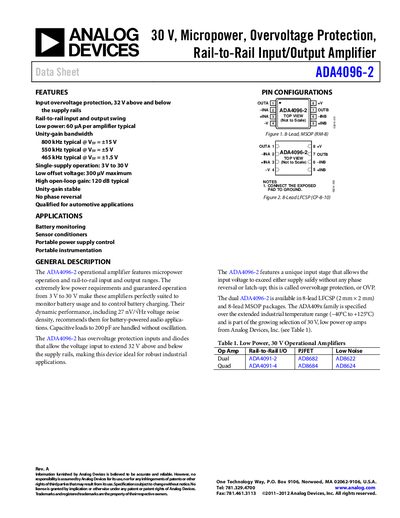
Analog Devices ADA4096-2 Datasheet
The ADA4096-2 operational amplifier from Analog Devices offers rail‑to‑rail input and output swing, low power consumption (60 µA per amplifier typical) and built‑in input over‑voltage protection that allows the input to exceed the supply rails by ±32 V. It is designed for battery monitoring, sensor conditioning, portable power‑supply control and other battery‑powered applications, and it operates from a single supply of 3 V to 30 V.
The device is available in 8‑lead MSOP and LFCSP packages, qualified for an extended industrial temperature range (‑40 °C to +125 °C) and automotive use. Detailed electrical specifications are provided for supply voltages of 1.5 V, 5 V and 15 V, covering offset voltage, bias current, gain‑bandwidth product, noise performance and absolute maximum ratings.
Analog Devices ADA4096-2 specifications
| Supply Voltage (absolute max) | 36 V |
|---|---|
| Input Offset Voltage (typical) | 300 µV |
| Input Bias Current (typical, Vsy=+15 V) | 15 nA |
| Unity‑gain bandwidth (typical, Vsy=+15 V) | 800 kHz |
| Power Supply Rejection Ratio (typical) | 100 dB |
| Voltage Noise Density (1 kHz) | 27 nV/√Hz |
All Analog Devices ADA4096-2 documents by type
Ratings, dimensions and ordering codes, for selection and design work.
Questions answered in these manuals
What input over‑voltage protection range does the ADA4096‑2 provide?
The device allows the input voltage to extend 32 V above and below the supply rails.
Is the ADA4096‑2 qualified for automotive applications?
Yes, automotive‑grade models are available and are qualified for automotive reliability requirements.
What is the input overvoltage protection range?
The inputs can tolerate voltages up to 32 V above and 32 V below the supply rails.
Is the ADA4096‑2 qualified for automotive use?
Yes, automotive‑grade models (designated with “W”) are available and meet automotive reliability requirements.