
Key facts
- Brand
- Intersil
- Model
- ISL6622
- Category
- Other Electronics
- Industry
- Electronics
- Documents
- 3
- Languages
- EN
- Last added
- 2012-03-28
Start here
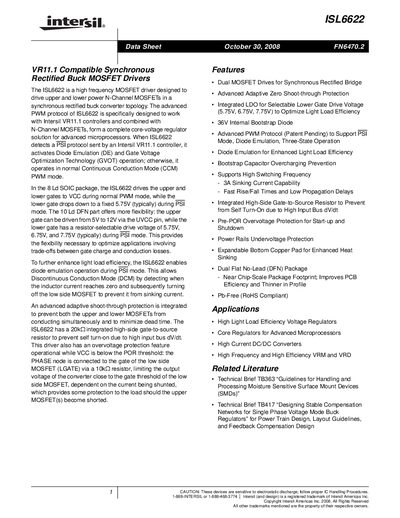
Intersil ISL6622 Datasheet
The ISL6622 is a high‑frequency MOSFET driver designed to drive upper and lower N‑Channel MOSFETs in a synchronous‑rectified buck converter. It supports an advanced PWM protocol that works with Intersil VR11.1 controllers and includes features such as diode emulation, gate‑voltage optimization, and adaptive shoot‑through protection.
Key features include dual MOSFET drives, selectable lower‑gate voltage (5.75 V, 6.75 V, 7.75 V) via an integrated LDO, a 20 kΩ high‑side gate‑to‑source resistor, 3 A sinking capability, and options for 8‑lead SOIC or 10‑lead DFN packages. The datasheet lists electrical specifications, pin functions, timing diagrams, and recommended operating conditions for designers.
Intersil ISL6622 specifications
| Supply Voltage (VCC, UVCC) | 0–15 V |
|---|---|
| Upper Drive Source Current | 1.25 A |
| Upper Drive Sink Current | 2 A |
| Lower Drive Source Current | 2 A |
| Lower Drive Sink Current | 3 A |
| Selectable Lower Gate Drive Voltage | 5.75 V, 6.75 V, 7.75 V |
| High‑Side Gate‑to‑Source Resistor | 20 kΩ |
Source: Intersil ISL6622 Datasheet
All Intersil ISL6622 documents by type
Ratings, dimensions and ordering codes, for selection and design work.
Questions answered in these manuals
How does the ISL6622 prevent shoot‑through?
It uses an advanced adaptive shoot‑through protection circuit that monitors the gate voltages and inserts a dead‑time, ensuring the upper and lower MOSFETs never conduct at the same time.
What is the maximum sinking current capability of the ISL6622?
The device can sink up to 3 A of current.
What is the maximum supply voltage for the ISL6622A?
The device can operate with supply voltages up to 15 V.
How much sinking current can the lower MOSFET driver handle?
It can sink up to 3 A.
What does diode‑emulation mode do in the ISL6622B?
It turns off the lower MOSFET when the inductor current reaches zero, allowing discontinuous conduction mode and improving light‑load efficiency.
What supply voltage ranges are supported for VCC and UVCC?
VCC operates from 6.8 V to 13.2 V, while UVCC can be supplied between 5 V and 12 V.