
Key facts
- Brand
- Intersil
- Model
- ISL9000
- Category
- Other Electronics
- Industry
- Electronics
- Documents
- 3
- Languages
- EN
- Last added
- 2012-03-28
Start here
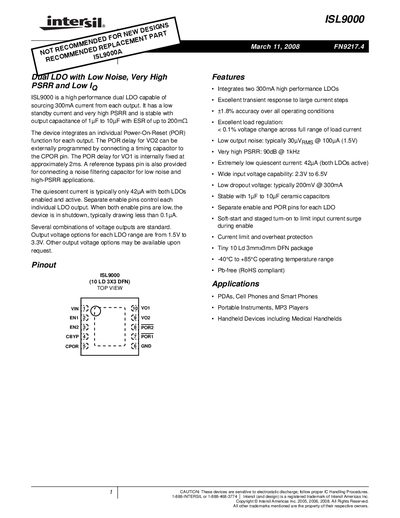
Intersil ISL9000 Dual LDO Datasheet
The ISL9000 is a high‑performance dual low‑dropout regulator (LDO) capable of sourcing 300 mA per output with low standby current, excellent transient response, and very high PSRR. Each LDO includes independent enable and power‑on‑reset pins, soft‑start, current‑limit, and over‑heat protection. The device operates from 2.3 V to 6.5 V input and offers selectable output voltages from 1.5 V to 3.3 V.
The datasheet includes ordering information, absolute maximum ratings, recommended operating conditions, detailed electrical specifications, typical performance curves, pin descriptions, and a typical application circuit. The ISL9000 is supplied in a 10‑lead DFN (3 mm × 3 mm) package and is RoHS‑compliant.
Intersil ISL9000 specifications
| Output current per LDO | 300 mA |
|---|---|
| Quiescent current (both LDOs active) | 42 µA |
| Dropout voltage (typical at 300 mA) | 200 mV |
| PSRR (1 kHz) | 90 dB |
| Input voltage range | 2.3 V – 6.5 V |
| Selectable output voltage range | 1.5 V – 3.3 V |
| Package | 10‑lead DFN 3 mm × 3 mm |
All Intersil ISL9000 documents by type
Ratings, dimensions and ordering codes, for selection and design work.
Questions answered in these manuals
What is the quiescent current when both LDOs are active?
The device draws only about 42 µA with both LDOs enabled.
How can the POR delay for VO2 be adjusted?
By connecting a timing capacitor to the CPOR pin; the delay is roughly 200 ms per 0.01 µF.
What is the quiescent current when both LDOs are active?
The typical quiescent current is 42 µA with both LDOs enabled.
How can the POR delay for VO2 be programmed?
By connecting a timing capacitor to the CPOR pin; the VO1 POR delay is fixed at about 2 ms.
What is the quiescent current when both LDOs are enabled?
The quiescent current is typically only 42 µA with both LDOs enabled and active.
How can the POR delay for VO2 be programmed?
By connecting a timing capacitor to the CPOR pin, the POR delay for VO2 can be externally programmed.