
Key facts
- Brand
- Intersil
- Model
- HIP1011
- Category
- Other Electronics
- Documents
- 5
- Languages
- EN
- Last added
- 2012-05-07
Start here
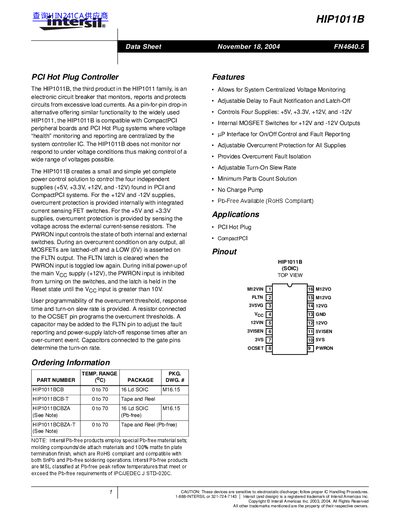
Intersil HIP1011B PCI Hot Plug Controller Datasheet
The HIP1011B is a drop‑in replacement for the HIP1011, providing centralized voltage monitoring and fault reporting for CompactPCI and PCI Hot‑Plug systems. It controls four independent supplies (+5 V, +3.3 V, +12 V, –12 V) and offers internal MOSFET switches for the ±12 V rails while the +5 V and +3.3 V rails use external current‑sense resistors.
Key features include adjustable delay to fault notification, programmable over‑current thresholds via the OCSET pin, a fault output (FLTN) that latches off all switches, and a PWRON input that globally enables or disables the four power switches. The device is RoHS‑compliant and available in Pb‑free packages.
Intersil HIP1011 specifications
| Supply Voltage Range (VCC) | +10.8 V to +13.2 V |
|---|---|
| Operating Temperature Range (Ta) | 0 °C to 70 °C |
| Overcurrent Fault Response Time | 500 ns to 960 ns |
| PWRON Threshold Voltage | typical 1.6 V |
All Intersil HIP1011 documents by type
Ratings, dimensions and ordering codes, for selection and design work.
Questions answered in these manuals
How is the over‑current protection threshold set?
A resistor connected from the OCSET pin to ground programs the over‑current trip point for all four switches.
What does the PWRON pin do?
The PWRON pin controls all four switches; a high level turns them on, while a low level turns them off.
What does the FLTN pin indicate?
FLTN is a fault output pin; a LOW level indicates a fault condition.
From: Intersil HIP1011D/HIP1011E Dual Slot PCI Hot Plug Controllers Datasheet
How is the over‑current threshold programmed?
By connecting a resistor between the OCSET pin (pin 10) and ground.
From: Intersil HIP1011D/HIP1011E Dual Slot PCI Hot Plug Controllers Datasheet
How is the over‑current threshold set?
A resistor connected from the OCSET pin to ground programs the over‑current trip point for all four switches.
What is the function of the FLTN pin?
The FLTN pin provides a fault output; it is a 5 V CMOS active‑low signal that indicates an over‑current or undervoltage condition.