
Key facts
- Brand
- Canon
- Model
- XH G1
- Industry
- Electronics
- Documents
- 5
- Languages
- EN · ZH
- Last added
- 2012-05-02
Start here
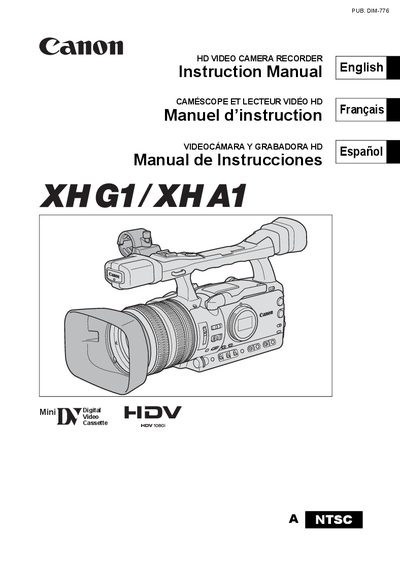
Canon XH G1 / XH A1 Camcorder Instruction Manual
This manual covers important safety and usage instructions, including warnings about fire, electric shock, and proper handling of the camcorder. It also details the supplied accessories, power‑adapter requirements, and how to prepare the camcorder and its battery.
The guide explains how to operate the device: selecting video standards (HD or SD), recording formats (HDV/DV), using the wireless controller, loading cassettes or memory cards, adjusting settings, and troubleshooting. Warranty terms and service information are provided at the end of the document.
Canon XH G1 specifications
| Video signal standard | HD (high definition) or SD (standard definition) |
|---|---|
| Power adapter model | CA-920 Compact Power Adapter, 100‑240 V AC |
| Supported memory cards | SDHC, SD, MMC |
All Canon XH G1 documents by type
Day-to-day operation, settings and troubleshooting. Start here if the product is already set up.
Questions answered in these manuals
What safety warnings should I follow before using the camcorder?
Read all safety and usage instructions, avoid exposing the camcorder to rain or moisture, use only recommended accessories, keep the power plug fully inserted, and do not modify the equipment unless instructed.
How do I power the camcorder?
Connect the CA‑920 Compact Power Adapter to a 100‑240 V AC outlet; the adapter has a polarized two‑prong plug that must be fully inserted.
What power adapter should be used with the camcorder?
The CA‑920 small power adapter must be used, and the CV‑250F DV cable is required to meet the EMC Directive requirements.
What type of memory cards are supported?
The camcorder supports SD, SDHC, and MultiMedia (MMC) cards.
What should I do before using the camcorder?
Read the manual carefully and keep it for future reference.
Can I open the camcorder’s housing for repair?
No, opening the housing is prohibited to avoid electric shock; service must be performed by qualified personnel.