
Key facts
- Brand
- Texas Instruments
- Model
- ADS1100
- Industry
- Industrial
- Documents
- 2
- Languages
- EN
- Last added
- 2012-05-04
Start here
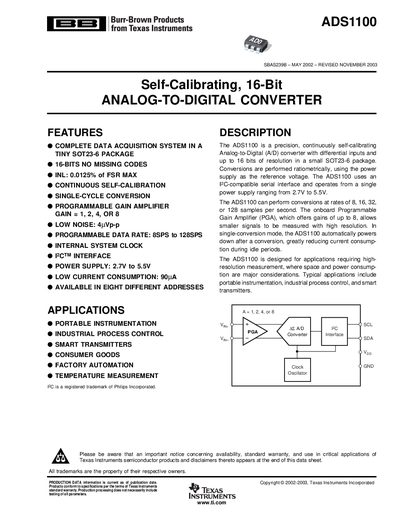
Texas Instruments ADS1100 Datasheet
The ADS1100 is a precision, continuously self‑calibrating 16‑bit ADC offered in a tiny SOT‑23‑6 package. It features a programmable gain amplifier (gain = 1, 2, 4, or 8), low noise (4 µV p‑p), and a selectable data rate from 8 SPS to 128 SPS. Power is supplied from 2.7 V to 5.5 V and the device consumes only about 90 µA in active mode. Communication is via a standard I²C (2‑wire) interface, and eight factory‑programmed I²C addresses are available.
The converter is intended for portable instrumentation, industrial process control, smart transmitters, consumer goods, factory automation, and temperature measurement. It operates from –40 °C to +125 °C, provides differential inputs with typical input impedances of 2.4 MΩ/PGA (differential) and 8 MΩ (common‑mode), and includes continuous self‑calibration that cannot be disabled.
Texas Instruments ADS1100 specifications
| Resolution | 16 bits (no missing codes) |
|---|---|
| Power‑supply voltage range | 2.7 V to 5.5 V |
| Active‑mode current consumption | 90 µA |
| Programmable gain options | 1, 2, 4, or 8 |
| Data‑rate options | 8 SPS to 128 SPS |
| Input noise | 4 µV p‑p |
| I²C address variants | Eight (1001aaa) |
| Package type | SOT‑23‑6 |
All Texas Instruments ADS1100 documents by type
Ratings, dimensions and ordering codes, for selection and design work.
Questions answered in these manuals
What power‑supply voltage does the ADS1100 require?
The device operates from a supply voltage of 2.7 V to 5.5 V.
How many I²C addresses are available for the ADS1100?
Eight different factory‑programmed I²C addresses are available (1001aaa).
What I²C address range does the ADS1100 use?
The ADS1100 uses an I²C address of the form 1001aaa, giving eight possible addresses such as 1001000 for the A0 variant and 1001011 for the A3 variant.
How does the ADS1100 perform self‑calibration?
The device includes a self‑calibration circuit that operates continuously and cannot be deactivated, ensuring gain and offset errors are compensated automatically.