
Key facts
Start here
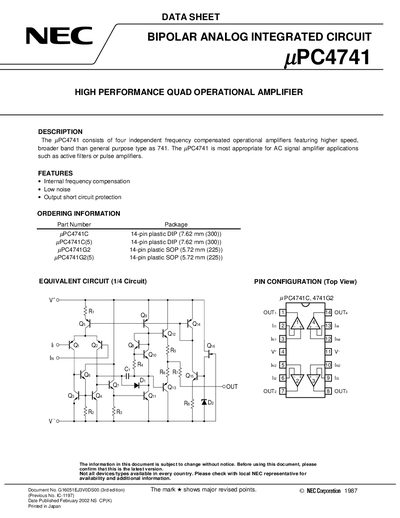
NEC uPC4741 Quad Operational Amplifier Datasheet
This document is a technical datasheet for the NEC uPC4741, a bipolar analog integrated circuit consisting of four independent frequency compensated operational amplifiers. It is designed for AC signal amplifier applications such as active filters or pulse amplifiers, offering higher speed and broader bandwidth than general purpose types like the 741.
The document provides comprehensive electrical characteristics including input offset voltage, bias current, slew rate, and common mode rejection ratio under various conditions. It also includes absolute maximum ratings, recommended operating conditions, typical performance curves, and detailed mechanical drawings for both the 14-pin plastic DIP (uPC4741C) and 14-pin plastic SOP (uPC4741G2) packages.
NEC uPC4741 specifications
| Input Offset Voltage (Typ) | < 2 mV |
|---|---|
| Slew Rate | 1.6 V/us |
| Common Mode Rejection Ratio (Typ) | 80 dB |
| Operating Ambient Temperature | -20 to +80 °C |
All NEC uPC4741 documents by type
Ratings, dimensions and ordering codes, for selection and design work.
Questions answered in these manuals
What is the maximum power dissipation rating for the uPC4741C package?
The absolute maximum power dissipation for the C package is 570 mW.
What is the typical input offset voltage of the uPC4741?
The typical input offset voltage is less than or equal to 2 mV.
What is the allowed supply voltage range for the uPC4741?
The device can be powered with a supply voltage from –0.3 V up to +40 V.
What are the recommended infrared reflow soldering conditions for the surface‑mount version?
Peak package surface temperature should be 230 °C or below, with a reflow time of 30 seconds or less (210 °C or higher).