
Key facts
Start here
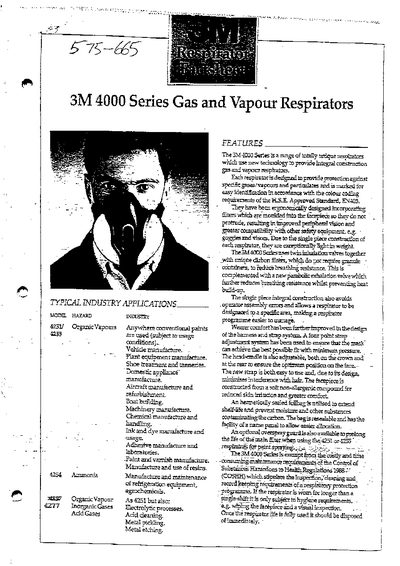
3M 4000 Series Gas and Vapour Respirator User Manual
The 3M 4000 Series is a half‑mask respirator designed to protect against a range of organic vapours, ammonia, inorganic and acid gases, and particulates. It features twin inhalation valves, colour‑coded filters, and an ergonomic head‑cradle for comfortable, secure wear.
The manual covers typical industry applications, key product features, field‑trial results, performance specifications, correct fitting procedures, and guidance on maintenance, disposal, and regulatory compliance.
3M 4000 Series specifications
| Product weight | 300 g max |
|---|---|
| Face piece material | Thermoplastic elastomer |
| Head harness material | Polypropylene/cotton braided elastic |
| Gas/Vapour filter media | Activated carbon |
| Particulate filter media | Polypropylene |
| Exhale valve material | Silicone rubber |
| Inhale valve material | Natural rubber |
| Standard compliance | EN 405, CE marked |
Source: 3M 4000 Series Gas and Vapour Respirators Data Sheet
All 3M 4000 Series documents by type
Ratings, dimensions and ordering codes, for selection and design work.
Day-to-day operation, settings and troubleshooting. Start here if the product is already set up.
Questions answered in these manuals
What standard does the 3M 4000 Series meet?
It meets the European Standard EN 405 for valved filtering half‑mask respirators and is CE marked.
What is the maximum weight of the respirator?
The respirator weighs up to 300 g.
How often should the respirator be replaced?
It should be replaced after 28 days or when breathing resistance increases or breakthrough occurs, whichever comes first.
From: 3M 4000 Series Maintenance Free Gas/Vapour and Particulate Respirators Manual
What type of filters do the 4000 Series respirators use?
They use two large bonded carbon filters that provide low breathing resistance.
From: 3M 4000 Series Maintenance Free Gas/Vapour and Particulate Respirators Manual
Can the 3M 4000 Series be used in IDLH conditions?
No, it must not be used in immediately dangerous to life or health (IDLH) concentrations.