
Key facts
- Model
- LINK-65
- Industry
- Industrial
- Documents
- 4
- Languages
- EN
- Last added
- 2012-07-04
Start here
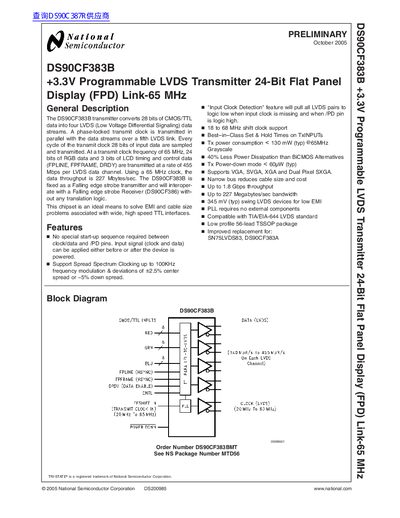
National semiconductor DS90CF383B +3.3V Programmable LVDS Transmitter 24-Bit Flat Panel Display (FPD) Link-65 MHz handbook
The DS90CF383B is a +3.3V programmable LVDS transmitter designed to convert 28 bits of CMOS/TTL data into four LVDS data streams and one transmit clock stream. It supports data rates up to 455 Mbps per channel, achieving a total throughput of 227 Mbytes/sec at 65 MHz. The device is compatible with the TI/EIA-644 LVDS standard and interoperates with falling edge strobe receivers.
Read onlineNational Semiconductor LINK-65 specifications
| Supply Voltage (Vcc) | 3.0 V to 3.6 V |
|---|---|
| Operating Temperature Range | -10°C to +70°C |
| Maximum Transmit Clock Frequency | 68 MHz |
| Typical Power Consumption @ 65MHz | < 60 mA |
| LVDS Differential Output Voltage | 345 mV (typ) |
| Data Throughput @ 65 MHz | 227 Mbytes/sec |
All National Semiconductor LINK-65 documents by type
Ratings, dimensions and ordering codes, for selection and design work.
- National semiconductor DS90CF383B +3.3V Programmable LVDS Transmitter 24-Bit Flat Panel Display (FPD) Link-65 MHz handbook 11 p
- National Semiconductor DS90C383B +3.3V Programmable LVDS Transmitter 24-Bit Flat Panel Display (FPD) Link-65 MHz handbook 11 p
- National Semiconductor DS90C383A/DS90CF383A +3.3V Programmable LVDS Transmitter 24-Bit Flat Panel Display (FPD) Link-65 MHz +3.3V LVDS Transmitter 24-Bit Flat Panel Display (FPD) Link-65 MHz handboo 11 p
- National Semiconductor DS90C363A/DS90CF363A +3.3V Programmable LVDS Transmitter 18-Bit Flat Panel Display (FPD) Link-65 MHz +3.3V LVDS Transmitter 18-Bit Flat Panel Display (FPD) Link-65 MHz handboo 10 p
Questions answered in these manuals
What is the supply voltage range for the DS90CF383B?
The recommended operating supply voltage (Vcc) ranges from 3.0 V to 3.6 V.
Does the DS90CF383B support spread spectrum clocking?
Yes, it supports Spread Spectrum Clocking up to 100KHz frequency modulation with deviations of +2.5% center spread or -5% down spread.
Does the DS90C383B require a special start-up sequence?
No, no special start-up sequence is required between clock/data and /PD pins.
What is the maximum transmit clock frequency?
The device supports a transmit clock frequency up to 65 MHz.
What is the maximum transmit clock frequency?
The device supports a transmit clock frequency up to 65 MHz.
Is the device compatible with the TIA/EIA-644 standard?
Yes, the chipset is compatible with the TIA/EIA-644 LVDS standard.