
Key facts
- Model
- DS90CR216
- Industry
- Industrial
- Documents
- 2
- Languages
- EN
- Last added
- 2012-07-04
Start here
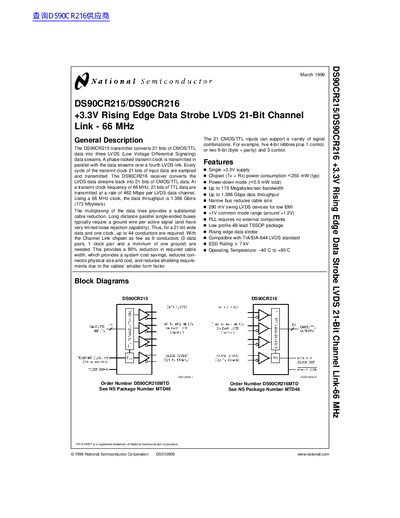
National Semiconductor DS90CR215/DS90CR216 Datasheet
Datasheet 16 pages · 296 KB · EN
The document describes the DS90CR215/DS90CR216 Channel Link chipset from National Semiconductor. The DS90CR215 transmitter converts 21 bits of CMOS/TTL data into three LVDS data streams, while the DS90CR216 receiver converts these streams back to CMOS/TTL data. Operating at a clock frequency of up to 66 MHz, the system achieves a data throughput of 1.386 Gbit/s.
Read onlineNational Semiconductor DS90CR216 specifications
| Operating Temperature Range | -40°C to +85°C |
|---|---|
| Data Throughput (Max) | 1.386 Gbps |
| Bandwidth | Up to 173 Megabytes/sec |
| LVDS Swing | 290 mV |
| Package Type | 48-lead TSSOP |
Source: National Semiconductor DS90CR215/DS90CR216 Datasheet
All National Semiconductor DS90CR216 documents by type
Datasheet 2
Ratings, dimensions and ordering codes, for selection and design work.
Questions answered in these manuals
What is the maximum clock frequency?
The transmit clock frequency supports up to 66 MHz.
How many conductors are required for the cable?
The chipset requires as few as 9 conductors (3 data pairs, 1 clock pair and a minimum of one ground).
What is the maximum transmit clock frequency?
The transmit clock frequency can be up to 66 MHz.
What is the ESD rating for these devices?
The devices have an ESD Rating greater than 7 kV.