
The DS90C363A/DS90CF363A +3.3V Programmable LVDS Transmitter is a transmitter that converts 21 bits of CMOS/TTL data into three LVDS data streams. It can transmit 18 bits of RGB data and 3 bits of LCD timing and control data at a rate of 455 Mbps per LVDS data channel with a clock frequency of 65 MHz.
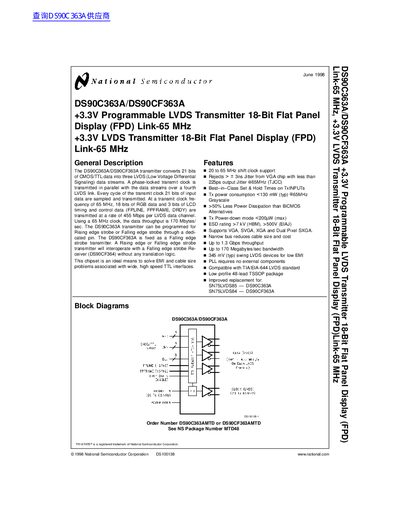
The DS90C363A/DS90CF363A transmitter converts 21 bits of CMOS/TTL data into three LVDS data streams and includes a phase-locked transmit clock. It supports clock frequencies from 20 to 65 MHz and is designed to solve EMI and cable size problems associated with wide, high-speed TTL interfaces. The device supports VGA, SVGA, XGA, and Dual Pixel SXGA resolutions.
| Supply Voltage (VCC) | 3.0V to 3.6V |
|---|---|
| Operating Temperature | -10°C to +70°C |
| Shift Clock Support | 20 to 65 MHz |
| Data Throughput | Up to 1.3 Gbps |
| Bandwidth | Up to 170 Megabytes/sec |
| LVDS Output Swing | 345 mV (typ) |
| Package Type | 48-lead TSSOP |
The transmitter supports a transmit clock frequency of up to 65 MHz.
Yes, the DS90C363A can be programmed for Rising edge strobe or Falling edge strobe through a dedicated pin.
The transmitter power-down mode consumes less than 200µW maximum.