
DS90CF383B is a +3.3V programmable LVDS transmitter from ST. It supports 24-bit FPD link and transmit frequency up to 65MHz. This device uses falling edge trigger, and can be used with DS90CF386 (falling edge trigger receiver) to solve the EMI and cable size problems associated with wide, high speed TTL interfaces.
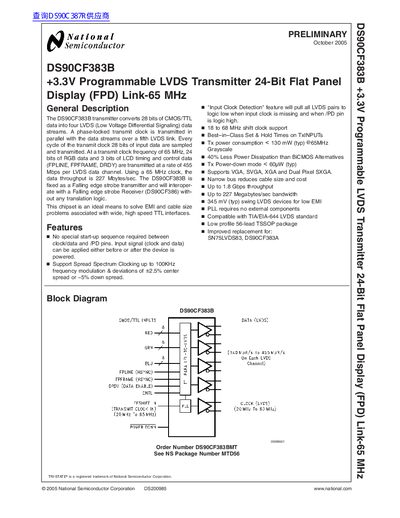
The DS90CF383B is a +3.3V programmable LVDS transmitter designed to convert 28 bits of CMOS/TTL data into four LVDS data streams and one transmit clock stream. It supports data rates up to 455 Mbps per channel, achieving a total throughput of 227 Mbytes/sec at 65 MHz. The device is compatible with the TI/EIA-644 LVDS standard and interoperates with falling edge strobe receivers.
| Supply Voltage (Vcc) | 3.0 V to 3.6 V |
|---|---|
| Operating Temperature Range | -10°C to +70°C |
| Maximum Transmit Clock Frequency | 68 MHz |
| Typical Power Consumption @ 65MHz | < 60 mA |
| LVDS Differential Output Voltage | 345 mV (typ) |
| Data Throughput @ 65 MHz | 227 Mbytes/sec |
The recommended operating supply voltage (Vcc) ranges from 3.0 V to 3.6 V.
Yes, it supports Spread Spectrum Clocking up to 100KHz frequency modulation with deviations of +2.5% center spread or -5% down spread.