
This document introduces the principle and application of thermocouple measurement.
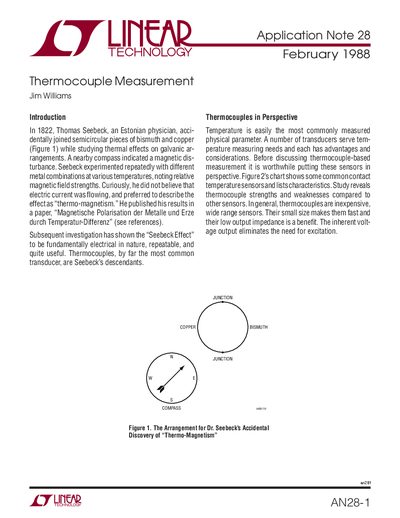
The document provides a historical overview of the Seebeck Effect and discusses various temperature sensors. It details specific characteristics of common thermocouple materials such as Copper-Constantan, Iron-Constantan, and Platinum-Rhodium alloys.
The text addresses signal conditioning challenges like low-level outputs and nonlinearity. It explains the necessity of cold junction compensation for absolute accuracy and describes typical circuit arrangements using components like the LT1025 IC to simulate ice baths or track ambient temperature.
| Platinum 10%-Rhodium Temperature Range | 0 to 1550 °C |
|---|---|
| LT1025 Accuracy | 0.5°C |
It is a fundamentally electrical phenomenon where joining different metals at various temperatures creates an electric current, originally described as 'thermo-magnetism' by Thomas Seebeck.
It is required because unintended parasitic thermocouples form at connections, making it difficult to achieve system accuracies better than 0.5°C without a temperature reference.
It measures ambient temperature and outputs a voltage scaled for use with specific thermocouple types, allowing one part to be used with many different thermocouples.