
Key facts
- Brand
- Analog Devices
- Model
- 1B32
- Industry
- Industrial
- Documents
- 3
- Languages
- EN
- Last added
- 2012-03-26
Start here
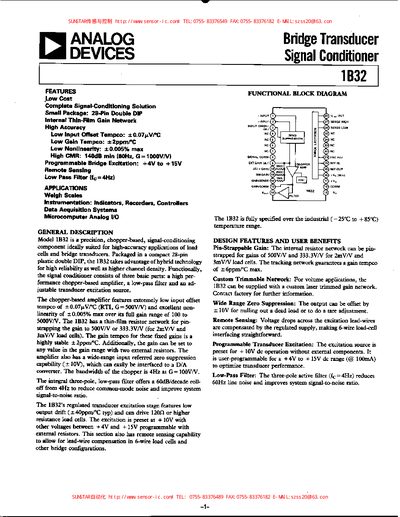
Analog Devices 1B32 Signal Conditioner Manual
The 1B32 is a precision, chopper‑based signal‑conditioning component designed for high‑accuracy load‑cell and bridge transducer applications. It combines a low‑noise amplifier, a three‑pole low‑pass filter and a programmable bridge excitation source in a compact 28‑pin double‑DIP package.
The manual details the device’s gain options, remote‑sensing capability, power‑supply requirements, input protection, and application examples such as pressure transducer interfaces and mobile data‑acquisition systems.
Analog Devices 1B32 specifications
| Input Offset Voltage (Initial, RTI) | +40 pV |
|---|---|
| Input Bias Current (Initial @25°C) | +3 nA |
| Low‑Pass Filter Cutoff Frequency | 4 Hz (‑3 dB point) |
| Power Supply Rated Voltage | 18 V |
Source: Analog Devices 1B32 Bridge Transducer Signal Conditioner Handbook
All Analog Devices 1B32 documents by type
Day-to-day operation, settings and troubleshooting. Start here if the product is already set up.
Ratings, dimensions and ordering codes, for selection and design work.
Questions answered in these manuals
What is the programmable bridge excitation voltage range?
The bridge excitation can be programmed from +4 V to +15 V using external resistors.
From: Analog Devices 1B32 Bridge Transducer Signal Conditioner Handbook
What is the low‑pass filter cutoff frequency?
The low‑pass filter has a 3‑pole design with a cutoff (‑3 dB) at 4 Hz.
From: Analog Devices 1B32 Bridge Transducer Signal Conditioner Handbook
What is the programmable bridge excitation voltage range?
The bridge excitation can be programmed from +4 V to +15 V.
What is the low‑pass filter cutoff frequency?
The low‑pass filter has a 3 dB cutoff frequency of 4 Hz.