
Key facts
- Brand
- Maxim
- Model
- MAX7300
- Documents
- 2
- Languages
- EN
- Last added
- 2012-04-05
Start here
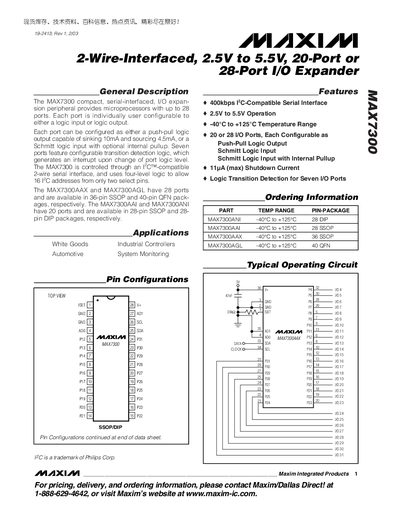
Maxim MAX7300 I/O Expander Datasheet
The MAX7300 is a compact, serial‑interfaced I/O expansion peripheral that offers either 20 or 28 configurable ports. Each port can be set as a push‑pull output or a Schmitt‑trigger input with optional internal pull‑up, and seven ports include transition‑detection logic that can generate an interrupt.
The device operates over a 2.5 V to 5.5 V supply range, supports temperatures from –40 °C to +125 °C, and communicates via an I²C‑compatible two‑wire serial interface. Various package options (SSOP, QFN, DIP) provide flexibility for different board designs.
Maxim MAX7300 specifications
| Operating Supply Voltage | 2.5 V to 5.5 V |
|---|---|
| Temperature Range | -40 °C to +125 °C |
| Number of I/O Ports | 20 or 28 |
| Output Source Current | 4.5 mA |
| Shutdown Current | 11 pA (max) |
All Maxim MAX7300 documents by type
Ratings, dimensions and ordering codes, for selection and design work.
Questions answered in these manuals
What interface does the MAX7300 use?
It uses an I²C‑compatible two‑wire serial interface.
How many I/O ports are available on the MAX7300?
The device provides either 20 or 28 configurable I/O ports, depending on the package.
How many ports can be configured as inputs or outputs?
The device provides either 20 or 28 ports, each individually configurable as an input or output.
From: MAXIM MAX7300 2-Wire-Interfaced 2.5V to 5.5V 20-Port or 28-Port I/O Expander Manual
What is the maximum serial clock frequency?
The serial clock can operate up to 400 kHz.
From: MAXIM MAX7300 2-Wire-Interfaced 2.5V to 5.5V 20-Port or 28-Port I/O Expander Manual