
The MAX7300 is a compact, serial-interfaced, I/O expansion peripheral that provides microprocessors with up to 28 ports. Each port is individually user configurable to either a logic input or logic output. Each port can be configured as either a push-pull logic output capable of sinking 10mA and sourcing 4.5mA, or a Schmitt logic input with optional internal pullup. Seven ports feature configurable transition detection logic, which generates an interrupt upon change of port logic level. The MAX7300 is controlled through an I2C-compatible 2-wire serial interface, and uses four-level logic to allow 16 I2C addresses from only two select pins. The MAX7300AAX and MAX7300ATL have 28 ports and are available in 36-pin SSOP and 40-pin TQFN packages, respectively. The MAX7300AAI and MAX7300ATI have 20 ports and are available in 28-pin SSOP and TQFN packages. For an SPI-interfaced version, refer to the MAX7301 data sheet. For a pin-compatible port expander with additional 24mA constant-current LED drive capability, refer to the MAX6956 data sheet.
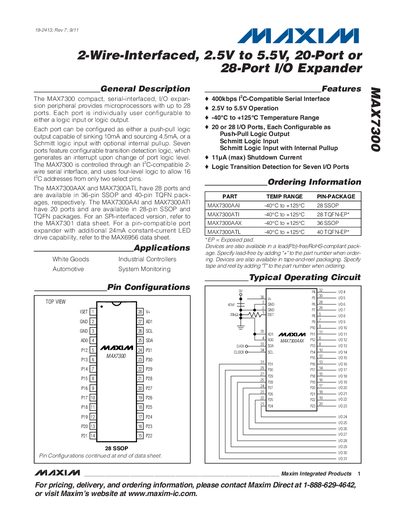
The MAX7300 is a compact, serial‑interfaced I/O expansion peripheral that provides microprocessors with up to 28 ports. Each port can be individually configured as a push‑pull logic output or a Schmitt‑trigger logic input, with optional internal pull‑up resistors. Seven ports include transition‑detection logic that can generate an interrupt on a change of state.
The device operates over a 2.5 V to 5.5 V supply range, supports a 400 kHz I²C‑compatible serial clock, and is rated for -40 °C to +125 °C. It is offered in 20‑port (28‑pin SSOP/TQFN) and 28‑port (36‑pin SSOP or 40‑pin TQFN) packages, with lead‑free and tape‑and‑rewind options available.
| Number of I/O Ports | 20 or 28 |
|---|---|
| Output Sink Current | 10 mA |
| Output Source Current | 4.5 mA |
| Serial Clock Frequency | 400 kHz |
| Operating Temperature Range | -40 °C to +125 °C |
The device provides either 20 or 28 ports, each individually configurable as an input or output.
The serial clock can operate up to 400 kHz.