
Key facts
- Brand
- Honeywell
- Model
- HX6656
- Industry
- Industrial
- Documents
- 3
- Languages
- EN
- Last added
- 2012-06-11
Start here
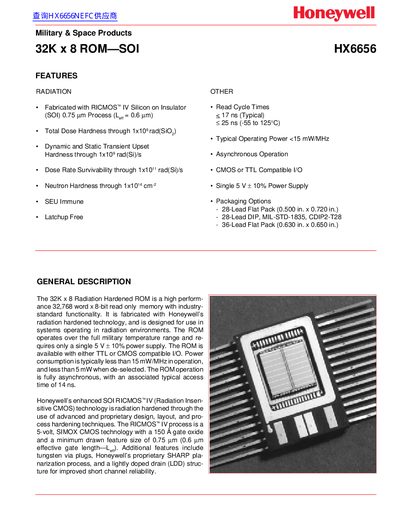
Honeywell HX6656 32K x 8 ROM Datasheet
The Honeywell HX6656 is a high-performance 32,768 word by 8-bit read-only memory (ROM) designed for use in systems operating in radiation environments. It is fabricated using Honeywell's RICMOS IV Silicon on Insulator (SOI) technology to ensure total dose hardness through 1x10^9 rad(SiO2), dynamic and static transient upset hardness, and neutron hardness.
The device operates over a full military temperature range of -55°C to +125°C with a single 5V power supply. It supports both TTL and CMOS compatible I/O levels and offers asynchronous operation with typical read cycle times under 17 ns. The HX6656 is available in 28-lead Flat Pack, 36-lead Flat Pack, and 28-Lead DIP packages.
Honeywell HX6656 specifications
| Memory Size | 32K x 8 (32,768 words x 8-bit) |
|---|---|
| Total Dose Hardness | 1x10^9 rad(SiO2) |
| Transient Upset Hardness | 1x10^8 rad(Si)/s |
| Neutron Hardness | 1x10^9 n/cm2 |
| Operating Temperature Range | -55°C to +125°C |
| Supply Voltage | Single 5 V +/- 10% |
| Typical Read Cycle Time | < 17 ns |
All Honeywell HX6656 documents by type
Ratings, dimensions and ordering codes, for selection and design work.
Questions answered in these manuals
What is the memory capacity of the HX6656?
The device contains a high-performance 32,768 word x 8-bit read-only memory.
Is the HX6656 immune to latchup?
Yes, the ROM will not latch up due to any of the specified radiation exposure conditions.
What is the typical access time of the HX6656?
The typical read cycle time is less than 17 ns.
From: Honeywell HX66656 Manual
Is the device immune to single-event upsets?
Yes, all storage elements within the ROM are immune to single event upsets for LET >= 90 MeV/cm/mg.
From: Honeywell HX66656 Manual
Is the HX6656 immune to single event upsets?
Yes, all storage elements within the ROM are immune to single event upsets for LET >= 190 MeV/cm/mg^2.
What is the typical read cycle time?
The typical read cycle time is less than 17 ns.