
Key facts
- Brand
- Yamaha
- Model
- SREV1
- Industry
- Electronics
- Documents
- 2
- Languages
- EN
- Last added
- 2012-06-13
Start here
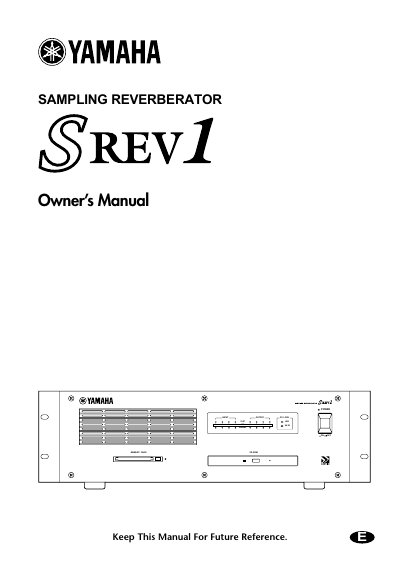
Yamaha SREV1 Sampling Reverberator Owner's Manual
The document serves as an Owner's Manual for the Yamaha SREV1 Sampling Reverberator. It provides essential information on handling the unit safely, including warnings about electrical shock, fire hazards, and proper ventilation requirements.
The manual details specific instructions for using accessories such as CD-ROMs and PC Cards, emphasizing correct storage and handling to prevent damage to the device or data loss. It also outlines precautions for transportation and maintenance.
All Yamaha SREV1 documents by type
Day-to-day operation, settings and troubleshooting. Start here if the product is already set up.
Questions answered in these manuals
What is the minimum clearance required behind the SREV1 for ventilation?
You must allow at least 20 cm of free space behind the unit.
How long should the unit acclimatize if moved from a cold place to a warmer environment?
The unit should be allowed to acclimatize for about one hour before use.
How does sound-field sampling work with the SREV1?
It involves firing SREV1 test pulses into an acoustic space, picking up the reverberation with microphones, and returning it to the SREV1 for processing.
What is the difference between an impulse signal and a TSP signal?
While both have a flat frequency response, a TSP (Time Stretched Pulse) contains a sweep of all frequencies providing higher sound pressure for better S/N ratio.