
This manual introduces the use of SREV1 Sampling Reverberator, including sampling principle, necessary equipment, sampling steps, etc.
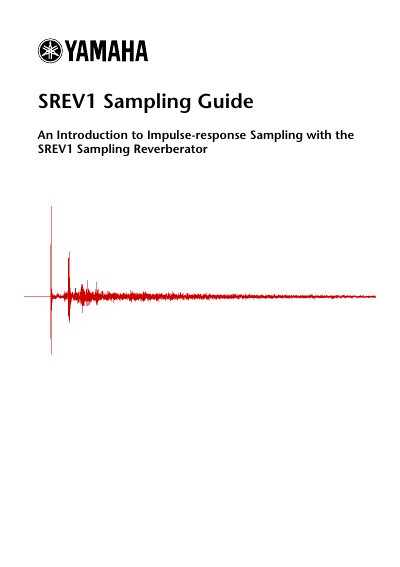
This document provides an introduction to sound-field sampling and explains concepts such as convolution, impulse response, and TSP signals. It details how the SREV1 captures reverberant characteristics of acoustic spaces to create reverb programs.
The guide includes a practical tutorial on configuring the RSampler, checking generator output, setting input levels, and performing actual sampling. It also covers post-processing steps like data editing, fixing noise (the 'roar'), removing delays, and adjusting reverb parameters.
It involves firing SREV1 test pulses into an acoustic space, picking up the reverberation with microphones, and returning it to the SREV1 for processing.
While both have a flat frequency response, a TSP (Time Stretched Pulse) contains a sweep of all frequencies providing higher sound pressure for better S/N ratio.
Averaging reduces noise levels by adding multiple samples together; since background noise is random, it increases less than the useful data.