
Key facts
- Brand
- Yamaha
- Model
- PCY10
- Category
- Other Electronics
- Industry
- Computers
- Documents
- 3
- Languages
- JA · EN · DE
- Last added
- 2012-06-12
Start here
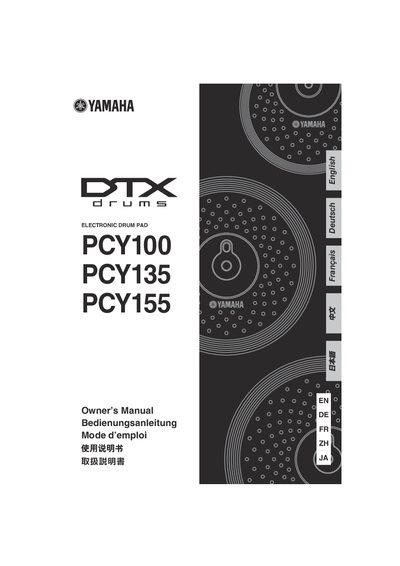
Yamaha PCY100/PCY135/PCY155 Electronic Drum Pad Owner's Manual
This document is the Owner's Manual for the Yamaha PCY100, PCY135, and PCY155 electronic drum pad units. It includes safety warnings, package contents lists, and assembly instructions for mounting the pads on a rack or cymbal stand.
The manual details the specific components included in the package for each model, such as the pad unit, stopper, felt pad, stereo phone cable, and manual copies. It also explains how to install the stopper on the cymbal holder using a tuning key and wing nut.
All Yamaha PCY10 documents by type
Day-to-day operation, settings and troubleshooting. Start here if the product is already set up.
Questions answered in these manuals
Can the PCY10 be used with other Yamaha cymbal pads?
Yes, it can be stacked on top of PCY60, 80, and 65 series cymbal pads to be used as a cup pad.
What should I do if crosstalk occurs when stacking the PCY10?
Turn the output level knob on the lower cymbal pad to the left to reduce output, or use the specific rejection function on the DTX series module.
What items are included in the package for each model?
The package includes one pad unit, one stopper, one felt pad, one stereo phone cable, and four copies of the Owner's Manual.
From: Yamaha PCY100/PCY135/PCY155 Electronic Drum Pad Owner's Manual
Where is the serial number located on the product?
The serial number can be found on or near the name plate, which is located on the bottom of the unit.
From: Yamaha PCY100/PCY135/PCY155 Electronic Drum Pad Owner's Manual
What items are included in the package for the PCY100, PCY135, and PCY155 pad units?
The package includes one pad unit, one stopper, one felt pad, one stereo phone cable, and four copies of the Owner's Manual.
How should the stopper be secured to the cymbal holder during assembly?
You must make the stopper make full contact with the bottom surface of the bolt cover before tightening the key bolt.