
Key facts
- Brand
- Maxim
- Model
- MAX712
- Industry
- Industrial
- Documents
- 2
- Languages
- EN
- Last added
- 2012-04-05
Start here
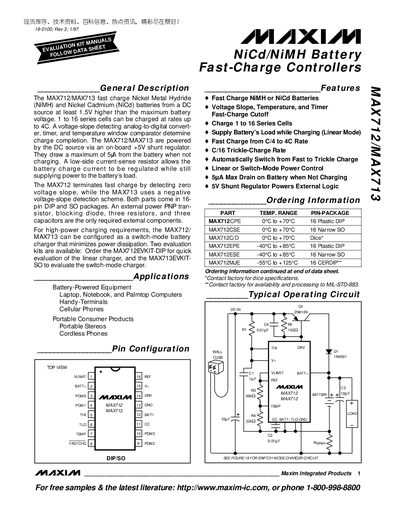
Maxim Integrated MAX712/MAX713 Fast-Charge Controller Datasheet
The MAX712 and MAX713 are fast‑charge controllers for NiMH and NiCd batteries. They can charge 1 to 16 series cells at rates up to 4C, using a voltage‑slope detector, temperature window comparator, and timer to determine charge completion. The devices are powered from a DC source via an on‑board +5 V shunt regulator and draw only a few milliamps when idle.
The datasheet provides pin descriptions, absolute maximum ratings, electrical characteristics, typical operating circuits, and programming tables for cell count, charge time, and current limits. It also includes ordering information for various temperature‑range packages and a chip topography diagram.
Maxim MAX712 specifications
| Maximum charge rate | up to 4C |
|---|---|
| Number of series cells supported | 1 to 16 |
| Shunt regulator output voltage | +5 V |
| Idle current draw (no charging) | 5.4 mA |
| Operating temperature range (DIP version) | 0 °C to +70 °C |
Source: Maxim Integrated MAX712/MAX713 Fast-Charge Controller Datasheet
All Maxim MAX712 documents by type
Ratings, dimensions and ordering codes, for selection and design work.
Questions answered in these manuals
What external components are required for the MAX712/MAX713?
An external power PNP transistor, a blocking diode, three resistors, and three capacitors are the only required external components.
From: Maxim Integrated MAX712/MAX713 Fast-Charge Controller Datasheet
How many cells can be charged with the MAX712/MAX713?
The devices can charge between 1 and 16 series cells.
From: Maxim Integrated MAX712/MAX713 Fast-Charge Controller Datasheet
How many series cells can the MAX712/MAX713 charge?
They can charge from 1 up to 16 series cells.
What external components are required for a basic circuit?
Only an external power PNP transistor, a blocking diode, three resistors, and three capacitors are needed.