
Key facts
- Brand
- Vaisala
- Model
- PDT102
- Industry
- Industrial
- Documents
- 4
- Languages
- EN · JA · FR
- Last added
- 2012-04-06
Start here
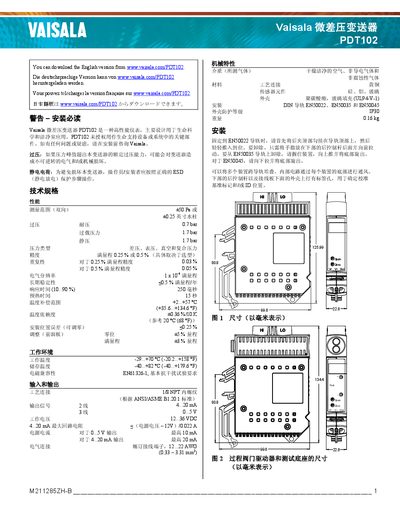
Vaisala PDT102 Quick Start Guide
The Vaisala PDT102 is a high‑performance differential pressure transmitter designed for life‑science and clean‑room applications. This quick guide provides essential installation instructions, wiring diagrams, and calibration procedures while noting safety considerations such as over‑pressure limits and ESD protection.
Key sections cover technical specifications, electrical wiring (voltage and current output), mechanical mounting on DIN rails, and step‑by‑step calibration using the optional front‑end test device or process valve driver.
Vaisala PDT102 specifications
| Measurement range (downward) | 50 Pa or 0.25 inH₂O |
|---|---|
| Over‑pressure rating | 0.7 bar |
| Burst pressure | 17 bar |
| Static pressure rating | 17 bar |
| Accuracy | 0.25 % span or 0.5 % span |
| Operating temperature | -29 °C to +70 °C |
| Housing rating | IP30 |
| Weight | 0.16 kg |
Source: Vaisala PDT102 User Manual
All Vaisala PDT102 documents by type
Day-to-day operation, settings and troubleshooting. Start here if the product is already set up.
The shortest path to a working setup, usually only a few pages.
Questions answered in these manuals
What is the operating voltage range for the PDT102?
The PDT102 operates from 12 VDC to 36 VDC, with the typical supply being 24 VDC.
What is the maximum length for shielded cable in voltage‑output wiring?
The maximum recommended length for shielded cable is 30 m.
What is the recommended maximum wiring length for the voltage output?
The voltage‑output wiring can be up to 30 meters (98.4 feet) long.
How often should the PDT102 be recalibrated?
Zero adjustment is done at installation, a re‑zero is required after 100 days, and a full recalibration is recommended annually.
What is the operating voltage range for the PDT102?
The PDT102 operates from 12 VDC to 36 VDC, with 24 VDC being the typical supply voltage.
How often should the zero point be adjusted or calibrated?
Zero‑point adjustment should be performed at the 100‑day mark after installation and then annually.