
Key facts
- Brand
- ON Semiconductor
- Model
- NCP1402
- Industry
- Industrial
- Documents
- 3
- Languages
- EN
- Last added
- 2012-08-01
Start here
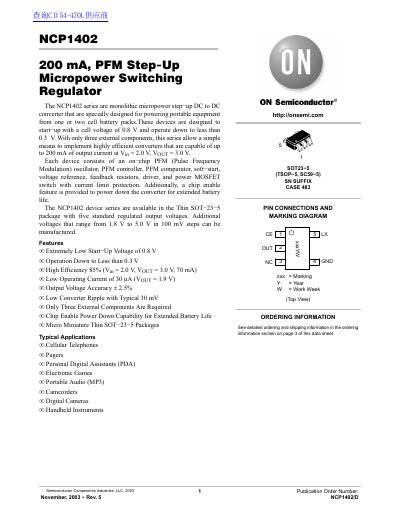
ON Semiconductor NCP1402 Datasheet
The NCP1402 series are monolithic micropower step-up DC to DC converters specifically designed for powering portable equipment from one or two cell battery packs. These devices can start up with a cell voltage of 0.8 V and operate down to less than 0.3 V, utilizing only three external components.
Read onlineON Semiconductor NCP1402 specifications
| Output Current | 200 mA |
|---|---|
| Efficiency | 85% |
| Output Voltage Accuracy | +/- 2.5% |
| Converter Ripple | 30 mV |
| External Components Required | Three |
All ON Semiconductor NCP1402 documents by type
Ratings, dimensions and ordering codes, for selection and design work.
Questions answered in these manuals
What is the minimum start-up voltage?
The device can start up with a cell voltage of 0.8 V.
What is the maximum output current capability?
The converter is capable of up to 200 mA of output current at specific conditions.
What is the minimum startup voltage?
The device can start up with a cell voltage of 0.8 V.
How many external components are required?
Only three external components are required to implement the converter.
What is the minimum start‑up voltage for the NCP1402?
The device can start up with a voltage as low as 0.8 V.
From: ON Semiconductor NCP1402 Step‑Up Switching Regulator Datasheet
How many external components are required to use the NCP1402?
Only three external components are required.
From: ON Semiconductor NCP1402 Step‑Up Switching Regulator Datasheet