
Key facts
- Brand
- Olympus
- Model
- BLL-1
- Industry
- Electronics
- Documents
- 2
- Languages
- EN
- Last added
- 2012-06-08
Start here
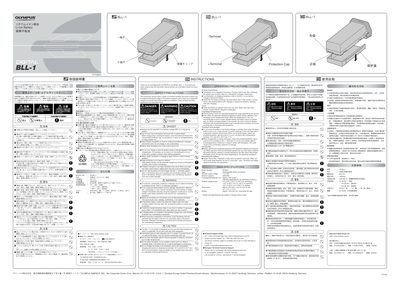
Olympus BLL-1 Li-ion Battery User Manual
This document provides comprehensive usage instructions for the Olympus BLL-1 Li-ion battery. It details essential safety precautions regarding charging, storage, and disposal to prevent injury or damage. The guide explains how to properly handle the battery terminals and manage temperature conditions during operation and recharging.
The manual outlines operating procedures such as initial charging requirements and cleaning methods. It also specifies technical data including voltage, capacity, dimensions, weight, and environmental temperature limits for use, storage, and charging.
Olympus BLL-1 specifications
| Type | Rechargeable lithium ion battery |
|---|---|
| Nominal output voltage | 7.2VDC |
| Nominal capacity | 3400mAh |
| Charging/discharging count | Approx. 500 cycles |
| Recharging temperature range | 10°C to 40°C (32°F to 104°F) |
| Operating temperature range | -10°C to 60°C (14°F to 140°F) |
| Storage temperature range | -20°C to 30°C (-4°F to 86°F) |
| Dimensions | Approx. 52.5 (W) x 112 (D) x 34 (H) mm |
| Weight | Approx. 195 g (6.9 oz) |
All Olympus BLL-1 documents by type
Day-to-day operation, settings and troubleshooting. Start here if the product is already set up.
Questions answered in these manuals
What charger should be used with this battery?
Always use the specified Li-ion battery charger {(BCL-1) to charge the battery.
What should be done if a child swallows the battery?
Swallowing a battery can be extremely dangerous; you must see a doctor immediately.
How should the battery be stored when not in use?
Attach the protection cap, store it in a cool, dry place at 15 °C‑25 °C, and keep it out of reach of children.
What must I do if the battery leaks or emits a burning odor?
Keep the battery away from heat sources, stop using it, and follow recycling instructions.