
Key facts
- Brand
- Intel
- Model
- Z77
- Category
- Other Computer Accessories
- Documents
- 2
- Languages
- EN
- Last added
- 2012-05-02
Start here
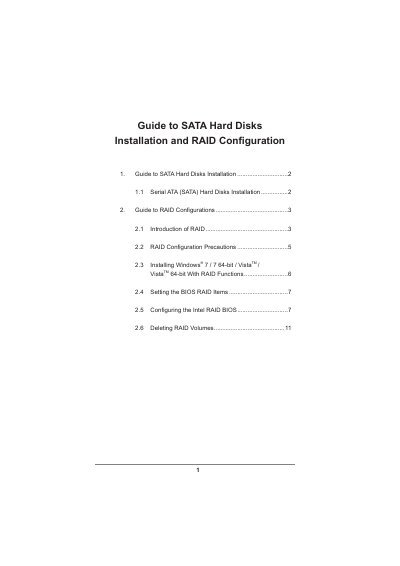
Intel Z77 Installation Guide for SATA Hard Disks and RAID Configuration
This guide explains how to install Serial ATA (SATA) hard disks on a motherboard that uses the Intel Z77 chipset and how to set up various RAID configurations. It covers RAID 0, RAID 1, RAID 5, RAID 10 and Intel Rapid Storage, including BIOS settings and Windows installation procedures.
Detailed instructions are provided for entering the BIOS, creating and deleting RAID volumes, selecting stripe sizes, and using the Intel RAID utility. The document also includes precautions, recommended drive configurations, and notes on operating system compatibility.
Intel Z77 specifications
| Supported RAID levels | RAID 0, RAID 1, RAID 5, RAID 10, Intel Rapid Storage |
|---|---|
| Number of SATA channels | Four independent SATA channels |
| Minimum drives for RAID 10 | Four hard disk drives |
| Minimum drives for RAID 5 | Three identical hard disk drives |
Source: Intel Z77 Installation Guide for SATA Hard Disks and RAID Configuration
All Intel Z77 documents by type
Mounting, wiring and first power-up. Read it before the hardware goes in.
Questions answered in these manuals
How do I enable RAID mode in the BIOS?
Set “SATA Mode Selection” to [RAID] in the BIOS setup utility.
From: Intel Z77 Installation Guide for SATA Hard Disks and RAID Configuration
What is the default stripe size for RAID 0?
The default stripe size is 128 KB.
From: Intel Z77 Installation Guide for SATA Hard Disks and RAID Configuration
How do I set the SATA mode to RAID in the BIOS?
Enter the BIOS setup utility, go to Advanced → Storage Configuration, and set “SATA Mode Selection” to [RAID].
From: Intel Z77 SATA Hard Disks Installation and RAID Configuration Guide
What stripe size values can I choose for a RAID 0 array?
You can select stripe sizes from 8 KB up to 128 KB, with 128 KB as the default.
From: Intel Z77 SATA Hard Disks Installation and RAID Configuration Guide