
Key facts
- Model
- LM1886
- Industry
- Industrial
- Documents
- 2
- Languages
- EN
- Last added
- 2012-04-05
Start here
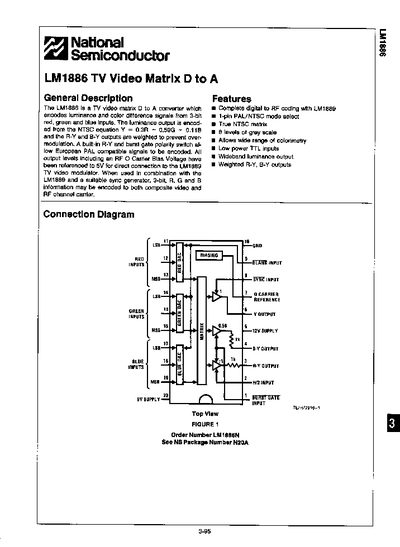
National Semiconductor LM1886 Video Matrix D to A Converter Datasheet
The LM1886 is a TV video matrix D to A converter that encodes luminance and color‑difference signals for PAL/NTSC operation. It accepts three binary‑weighted video inputs (red, green, blue) and produces weighted R‑Y, B‑Y, and luminance outputs referenced to a 5 V supply. The device can be combined with the LM1889 chroma modulator to generate composite video and RF carrier signals.
The datasheet includes absolute maximum ratings, electrical characteristics, typical input and output waveforms, test circuits, a typical application example, and a detailed circuit description. It also outlines the differences in pin configurations and internal switching for PAL versus NTSC encoding modes.
National Semiconductor LM1886 specifications
| Output Current | 5 mA |
|---|---|
| Power Dissipation (Ta = 25 °C) | 1900 mW |
| Storage Temperature Range | -55 °C to +150 °C |
| Operating Temperature Range | -40 °C to +70 °C |
| Lead Temperature (Soldering, 10 s) | 260 °C |
Source: National Semiconductor LM1886 Video Matrix D to A Converter Datasheet
All National Semiconductor LM1886 documents by type
Ratings, dimensions and ordering codes, for selection and design work.
Questions answered in these manuals
What are the storage temperature limits for the LM1886?
The device can be stored from –55 °C up to +150 °C.
From: National Semiconductor LM1886 Video Matrix D to A Converter Datasheet
What are the storage temperature limits for the LM1886?
The device can be stored from –55 °C up to +150 °C.
How fast does the LM1886 respond to changes on its inputs?
Typical rise time is 35 ns, fall time is 30 ns, and settling time is about 50 ns.