
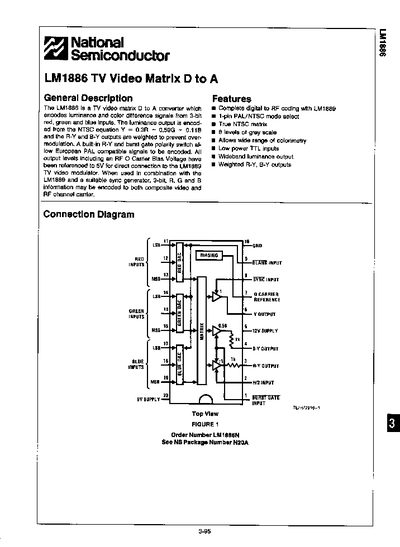
The LM1886 converts three video color inputs (red, green, blue) into a composite video signal with luminance and chroma components. It supports both NTSC and PAL standards, providing weighted R‑Y and B‑Y outputs and a built‑in burst gate for PAL compatibility.
Typical applications include integration with the LM1889 chroma modulator for TV video modulators, where the LM1886 supplies the luminance and color‑difference signals. The device operates from a 5 V supply and offers low‑power TTL‑compatible inputs, making it suitable for a range of broadcast and video processing equipment.
| Output Current | 5 mA |
|---|---|
| Power Dissipation (Ta = 25 °C) | 1900 mW |
| Storage Temperature Range | -55 °C to +150 °C |
| Operating Temperature Range | up to +70 °C |
| Lead Temperature (Soldering, 10 s) | 260 °C |
| Rise Time | 35 ns |
| Fall Time | 30 ns |
| Settling Time | 50 ns |
The device can be stored from –55 °C up to +150 °C.
Typical rise time is 35 ns, fall time is 30 ns, and settling time is about 50 ns.
The LM1886 has three 3‑bit inputs (red, green, blue), giving a total of nine input bits.